
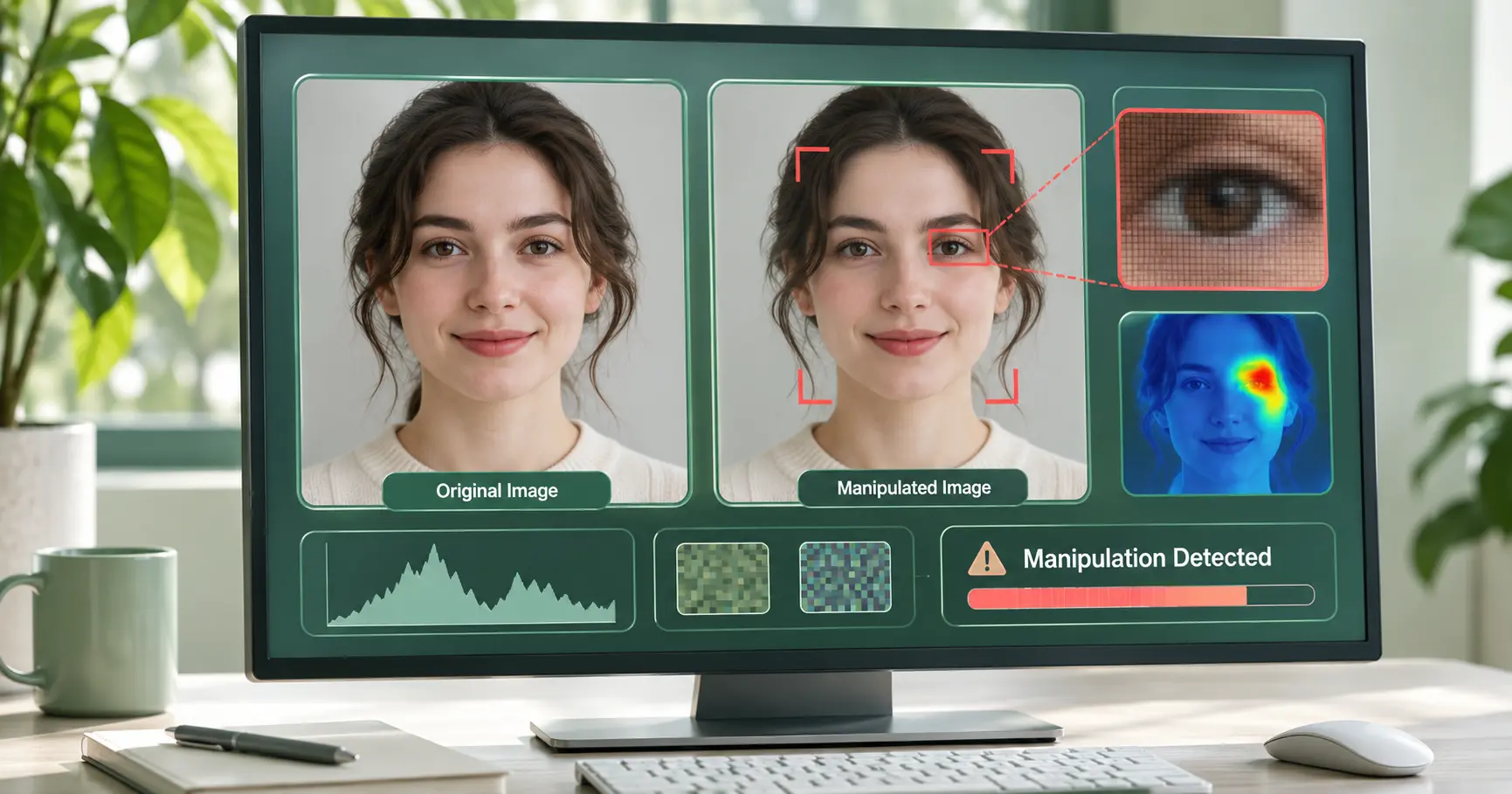
AI Image Manipulation Detection: 7 Essential Insights for Identifying Altered Digital Images
AI image manipulation detection is an advanced technology that helps identify digitally altered, forged, or artificially generated images. It uses artificial intelligence, machine learning, and computer vision to examine digital content for suspicious modifications.
Modern image editing software and generative AI tools make it increasingly easy to create realistic fake photographs. Criminals may use these technologies to manipulate identity documents, create misleading content, or attempt to bypass digital identity verification systems.
Traditional manual inspection is not always sufficient to identify sophisticated image modifications. AI-powered detection provides an additional layer of protection by analyzing patterns that may be difficult for humans to recognize.
This guide explains how image manipulation detection works, its main techniques, practical applications, implementation requirements, and limitations. It also explores how businesses can combine image analysis with other security technologies to improve digital trust.
Table of Contents
-
What Is AI Image Manipulation Detection?
-
How Does AI Image Manipulation Detection Work?
-
Essential Image Manipulation Detection Techniques
-
Real-World Applications and Benefits
-
Implementation, Challenges, and Best Practices
-
Frequently Asked Questions
-
Conclusion
1. What Is AI Image Manipulation Detection?
AI image manipulation detection is the process of using intelligent algorithms to identify potentially unauthorized or misleading modifications within digital images.
Unlike traditional image inspection, AI-powered systems can learn complex visual and statistical patterns associated with image editing. They may examine individual pixels, image textures, compression patterns, and relationships between different image regions.
The purpose is to estimate whether an image contains evidence of manipulation and, in some systems, identify the affected areas.
Common Types of Image Manipulation
Copy-move forgery
A person copies an area of an image and places it elsewhere within the same image. This technique may be used to hide an object or duplicate an existing element.
Image splicing
Elements from different photographs are combined into a single image.
AI-generated image manipulation
Generative AI creates or modifies specific areas of an image, including faces, objects, and backgrounds.
Face swapping
A person’s face is digitally replaced with another person’s face.
Document alteration
Information such as names, expiration dates, photographs, or identification numbers is digitally modified.
Object removal
An existing object is removed from an image, and the surrounding area is reconstructed to conceal the modification.
Not every image modification is fraudulent. Cropping, brightness adjustment, and color correction are common legitimate editing practices. Detection results must therefore be evaluated within their intended context.
2. How Does AI Image Manipulation Detection Work?
AI-powered image analysis typically involves several processing stages. The exact workflow depends on the detection model and its intended application.
Step 1: Image Acquisition
The system receives an image from a smartphone, desktop application, digital document, camera, or API request.
Image quality affects detection performance. Blurry photographs, excessive compression, and low-resolution files may contain fewer useful forensic signals.
Step 2: Image Preprocessing
The system prepares the image for analysis.
Preprocessing may include resizing, color normalization, dividing images into smaller regions, and extracting relevant visual features.
Original image files should also be preserved when appropriate because preprocessing can remove valuable forensic information.
Step 3: Feature Extraction
AI models examine characteristics that may indicate manipulation, including:
-
Inconsistent lighting and shadows.
-
Unusual pixel distributions.
-
Repeated image regions.
-
Irregular compression patterns.
-
Inconsistent image noise.
-
Abnormal textures and object boundaries.
-
Unnatural facial details.
Deep learning models can also learn additional features directly from training datasets.
Step 4: Manipulation Classification
The system evaluates extracted features and estimates the likelihood that an image has been manipulated.
Depending on the model, the result may include a classification, risk score, confidence value, or suspected manipulation category.
Step 5: Manipulation Localization
Some advanced models generate a heatmap or segmentation mask highlighting potentially altered regions.
Localization can help security analysts understand which parts of an image deserve further investigation.
Step 6: Security Decision
The application combines detection results with its security policies.
Low-risk submissions may continue through the verification process. Uncertain or suspicious results may require additional evidence, another capture attempt, or manual review.
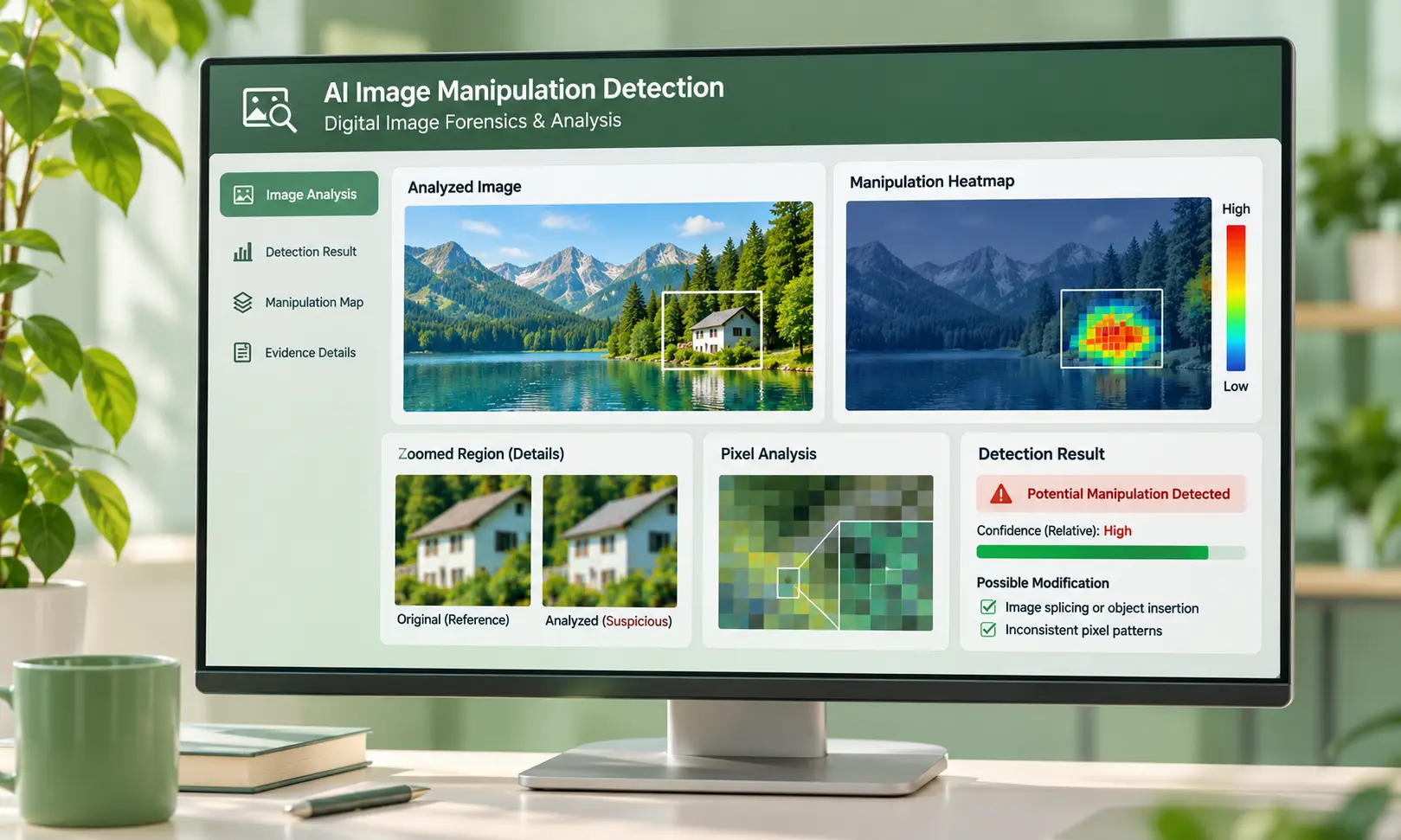
3. Essential Image Manipulation Detection Techniques
Modern image forensics combines several complementary techniques. Each method has different strengths and limitations.
Deep Learning Classification
Convolutional neural networks (CNNs) and vision transformers can learn visual characteristics associated with genuine and manipulated images.
These models can process complex image patterns without depending entirely on manually defined rules.
However, their effectiveness depends on training data quality and their ability to generalize to unfamiliar manipulation techniques.
Pixel and Noise Analysis
Digital cameras and image processing systems often introduce characteristic noise patterns.
When different image regions originate from different sources, their noise characteristics may become inconsistent.
Forensic algorithms can examine these differences to identify suspicious areas.
Compression Analysis
JPEG compression introduces characteristic patterns into digital images.
Repeated editing and saving may produce inconsistent compression artifacts. These patterns can provide useful forensic clues.
However, social media platforms and messaging applications also compress images. Compression differences alone do not establish fraud.
Metadata and Content Provenance Analysis
Image metadata may contain information about camera settings, timestamps, software, and file history.
Cryptographically signed content credentials provide another approach to evaluating recorded image history.
The C2PA Content Credentials Explainer describes how provenance information can complement digital forensics and media verification.
A valid credential does not guarantee that an image depicts a truthful event. Similarly, missing credentials do not establish that an image is fake.
C2PA+1
Image Manipulation Detection Methods Compared
| Detection technique | Primary purpose | Main limitation |
|---|---|---|
| Deep learning | Identify learned manipulation patterns | Unfamiliar attack methods |
| Pixel analysis | Examine statistical inconsistencies | Low image quality |
| Noise analysis | Identify differences between image regions | Noise reduction and compression |
| Compression analysis | Detect unusual encoding patterns | Legitimate image resaving |
| Metadata analysis | Examine available file history | Missing or modified metadata |
| Content provenance | Validate recorded content history | Limited credential availability |
| Manipulation localization | Highlight suspicious regions | Potentially inaccurate boundaries |
Combining multiple methods can provide more useful evidence than relying on a single detection technique.
4. Real-World Applications and Benefits
AI image manipulation detection has practical applications across industries that depend on trustworthy digital content.
Digital Identity Verification and KYC
Financial institutions and online services frequently collect identity documents and facial images during customer onboarding.
Manipulated photographs and altered identification documents may create security risks.
Businesses can combine image forensic analysis with document authentication, facial recognition, and biometric liveness detection.
Explore the MiniAiLive ID Document Liveness Detection SDK for technology focused on document presentation attacks and verification workflows.
Document liveness and image manipulation detection address different aspects of identity security. Using them together can support a more comprehensive verification process.
Banking and FinTech
Banks and financial technology companies may receive digitally submitted supporting documents during account opening, loan applications, and financial reviews.
Image analysis can help identify suspicious visual modifications in submitted evidence.
Potential cases can then be forwarded to fraud prevention teams for additional verification.
Insurance Fraud Prevention
Insurance companies often use photographs to evaluate property damage, vehicle accidents, and other claims.
Image forensic systems can help analysts investigate possible object removal, duplicated regions, and modified damage photographs.
Detection results should support investigators rather than automatically determine whether a claim is fraudulent.
Social Media and Digital Content Verification
Media organizations and online platforms can use image analysis to identify potentially manipulated visual content.
This technology may support content moderation, fact-checking, and digital investigations.
However, verifying the accuracy of an image also requires understanding its original context and source.
E-Commerce and Online Marketplaces
Online marketplaces depend on photographs to represent products and transactions.
Image manipulation analysis can support investigations into misleading product images, altered transaction evidence, and other suspicious submissions.
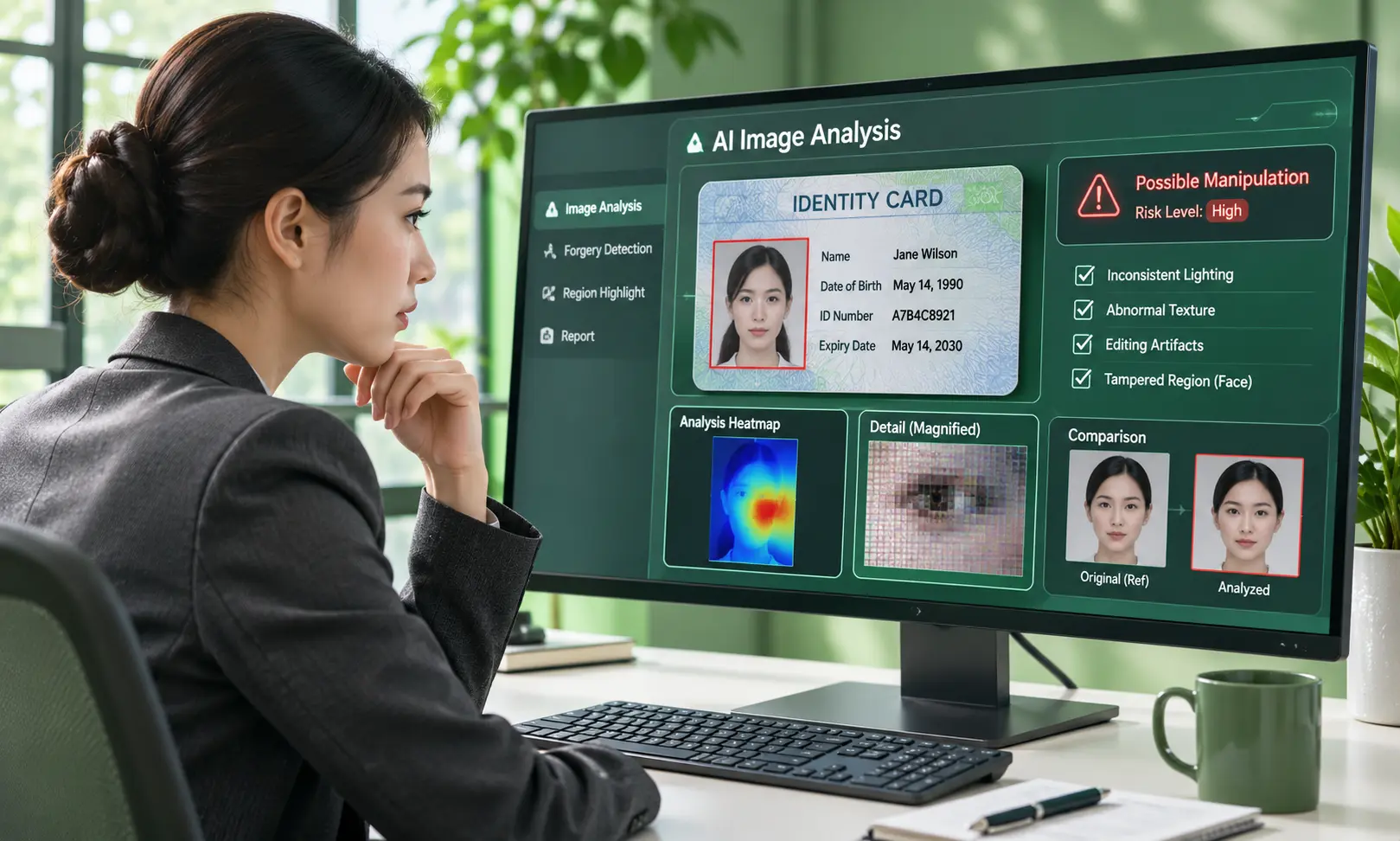
Illustration: A security professional reviewing suspicious digital documents and photographs in a modern fraud prevention environment.
5. Implementation, Challenges, and Best Practices
Organizations implementing AI image manipulation detection should establish clear technical and security requirements before deploying the technology.
Integrate Detection into Existing Applications
A typical implementation may follow this workflow:
-
Receive a digital image through an application.
-
Validate the file format and size.
-
Preserve the original image where appropriate.
-
Submit the image to a forensic analysis model or API.
-
Evaluate returned risk indicators.
-
Combine results with other verification checks.
-
Escalate uncertain results for manual review.
Developers should evaluate supported image formats, processing latency, deployment architecture, privacy requirements, and model compatibility before selecting a solution.
Combine Detection with Other Security Technologies
Image authenticity analysis should not operate as the only security control.
A comprehensive identity verification workflow may also include facial recognition, face liveness detection, document recognition, document liveness detection, and risk-based authentication.
Read MiniAiLive’s guide to fake ID detection software and authentication technologies to understand how these complementary approaches can support identity verification.
Understand False Positives and False Negatives
A false positive occurs when a genuine or legitimately edited image is incorrectly classified as suspicious.
A false negative occurs when a manipulated image passes the detection process without being identified.
Both errors can have significant consequences. Businesses should test detection thresholds using representative genuine and manipulated images before production deployment.
The NIST Digital Identity Guidelines for Identity Proofing address testing automated media analysis against genuine and manipulated content and incorporating human review to manage detection errors.
NIST Pages
Address Security and Privacy Requirements
Digital images may contain sensitive personal information, biometric data, and identity documents.
Organizations should establish appropriate safeguards, including encryption, restricted access, secure processing environments, and reasonable data retention policies.
Only authorized individuals should have access to sensitive image analysis results.
Maintain Detection Performance
Image editing tools and generative AI models continue to evolve.
Detection systems should be evaluated periodically against representative new manipulation techniques, legitimate editing operations, different camera sources, and varying image quality.
Performance should be measured using appropriate metrics, including precision, recall, false-positive rates, and false-negative rates.
No image manipulation detector can guarantee perfect accuracy across every image and editing method.
6. Frequently Asked Questions
What is AI image manipulation detection?
AI image manipulation detection uses artificial intelligence and digital image forensics to identify potentially altered, forged, or synthetically modified digital images.
Can AI detect edited photographs?
Yes. AI can identify certain editing patterns, inconsistent image features, and manipulation artifacts. Detection accuracy depends on the model, image quality, and editing method.
Can AI detect Photoshop modifications?
Some forensic models can identify evidence associated with conventional photo editing. However, not every Photoshop modification produces detectable evidence, and legitimate editing should not automatically be classified as fraud.
What is the difference between image manipulation detection and deepfake detection?
Image manipulation detection covers a broad range of digital modifications. Deepfake detection generally focuses on synthetic or manipulated media produced using deep learning, particularly altered human appearances, voices, or videos.
The two technologies overlap but are not identical.
Can image manipulation detection prevent identity fraud?
It can help identify suspicious digital evidence and reduce certain fraud risks. However, effective identity fraud prevention also requires document authentication, biometric verification, liveness detection, and appropriate security policies.
7. Conclusion
AI image manipulation detection is an important technology for improving digital content integrity and identifying potentially fraudulent images.
By combining deep learning, pixel analysis, image forensics, and complementary verification technologies, businesses can investigate suspicious modifications more effectively.
However, detection systems have limitations. Organizations should combine automated image analysis with appropriate security policies, representative performance testing, and human review.
Whether you are developing a financial application, digital onboarding platform, or identity verification system, a layered security approach can help improve trust.
Explore MiniAiLive’s AI-powered identity verification solutions to learn how biometric authentication and document liveness technologies can support your security infrastructure.