
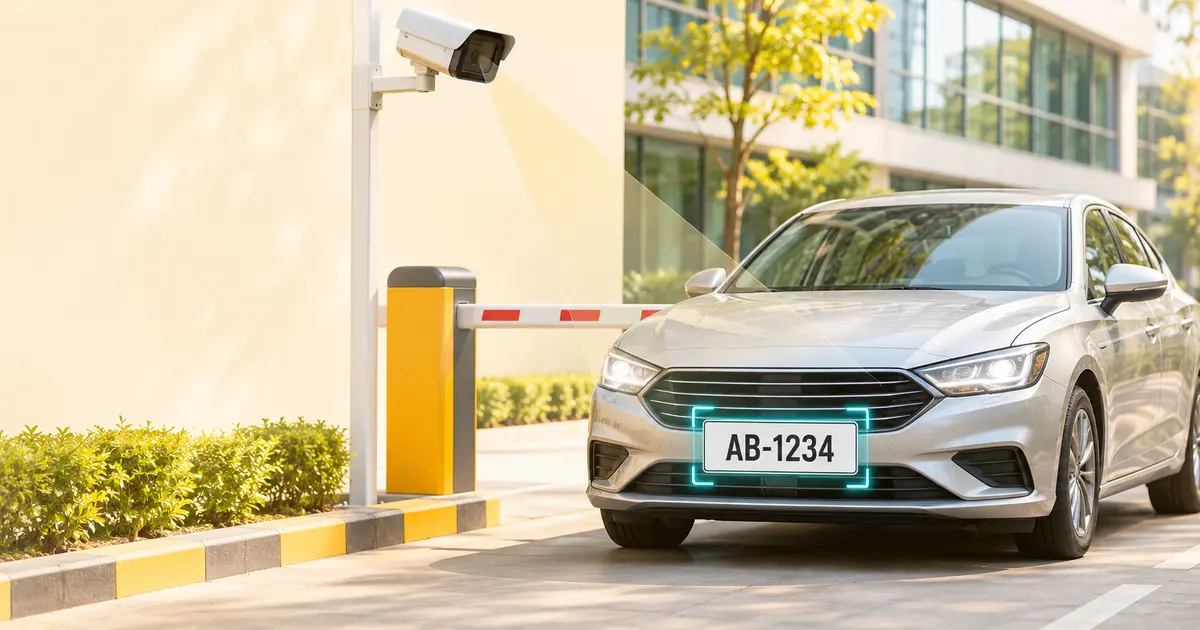
Vehicle license plate OCR uses artificial intelligence to read registration numbers from photos or video frames. Instead of asking a person to enter every plate number, a computer vision system identifies the plate and converts its characters into digital text. This can make parking, vehicle access, and traffic-related workflows easier to manage.
However, reading a plate is not the same as verifying a vehicle owner or confirming that a registration is valid. Camera conditions, plate designs, and data protection requirements all matter. In this guide, we explain how the technology works, where it helps, what can go wrong, and how developers can build a responsible recognition workflow. You will also learn what to evaluate when choosing a license plate recognition SDK.
Table of Contents
- What Is Vehicle License Plate OCR?
- How AI Extracts Registration Numbers
- Seven Practical Benefits and Applications
- Accuracy Challenges and How to Improve Results
- Building and Integrating a Reliable OCR Workflow
- Frequently Asked Questions
- Conclusion
What Is Vehicle License Plate OCR?
Optical character recognition, or OCR, turns text in an image into machine-readable characters. Vehicle license plate OCR applies this idea to the letters and numbers displayed on registration plates. It often works as part of a wider automatic license plate recognition system, called ALPR in many regions and ANPR in others.
Traditional text OCR focuses on document pages or scanned forms. A plate-reading system has a different challenge: it must first find a small plate in a much larger image of a moving or parked vehicle. It then needs to read characters despite changing light, camera angles, or weather.
A typical system produces a candidate registration string, such as ABC1234, together with information about the image or recognition result. The string can be checked against a permitted-vehicle list, parking record, or another authorized data source. A plate read alone does not establish the driver’s identity or ownership of the vehicle.
OCR, ALPR, and ANPR: What Is the Difference?
| Term | Main purpose | Practical meaning |
|---|---|---|
| OCR | Recognize text in an image | Converts plate characters into text |
| ALPR / ANPR | Detect and read license plates | Combines plate detection, OCR, and often event processing |
| Vehicle detection | Identify a vehicle in an image | Helps locate vehicles before or alongside plate detection |
| Registration lookup | Check a plate against permitted records | Requires a separate, authorized database or service |
How AI Extracts Registration Numbers
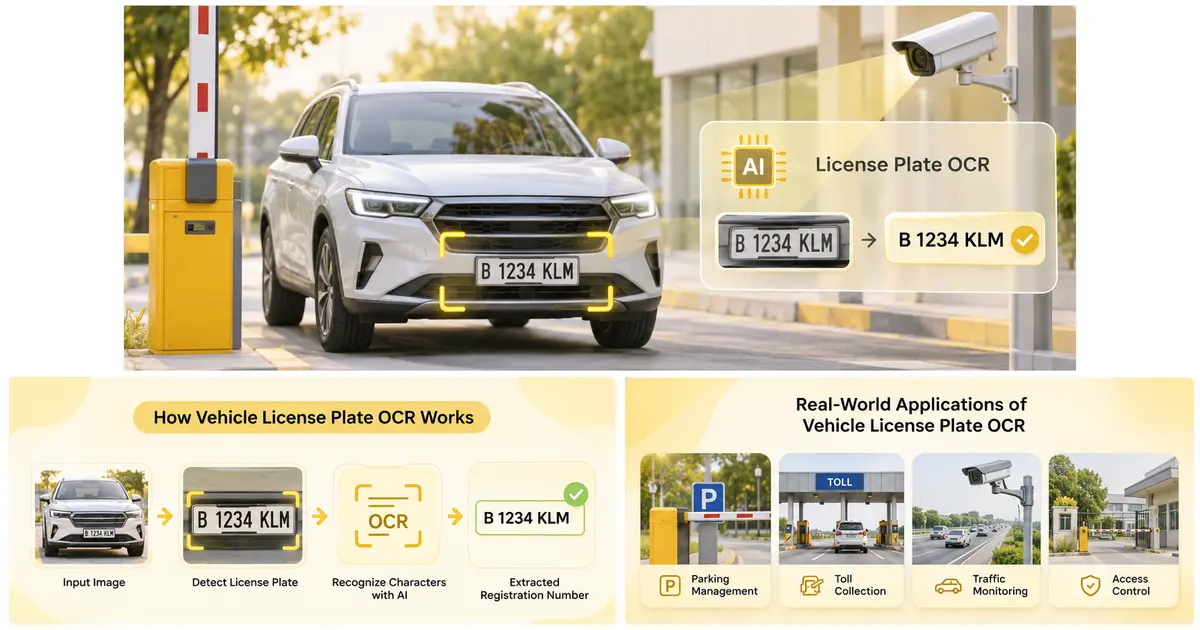
Modern plate-reading systems use computer vision and machine learning to locate plate regions and interpret their characters. The exact model design varies, but a practical pipeline usually follows five steps.
1. Capture an Image or Video Frame
A fixed camera, mobile device, or video stream captures the vehicle. Image quality depends on resolution, exposure, motion, and camera position. A camera that can see the entire car may still be too far away to capture the plate characters clearly.
2. Locate the License Plate
A detection model searches for a rectangular plate region within the larger scene. The output is commonly a bounding box around a candidate plate. Some systems first detect the vehicle to reduce the search area.
3. Prepare the Plate Image
The cropped plate may need resizing, perspective correction, contrast adjustment, or blur checks. These steps make letters easier to recognize. They do not restore details that were never captured in the original image.
4. Recognize and Validate Characters
An OCR model predicts letters and digits. The application may then check whether the result follows a plausible format for the relevant country or region. For example, it may reject a result with an impossible number of characters. Format checks can catch some errors, but they cannot prove that every character is correct.
5. Return a Result for Review or Automation
Finally, the system sends the detected string to the application. Developers can apply confidence thresholds, compare multiple video frames, or ask a person to review uncertain readings before an important action is taken.
Seven Practical Benefits and Applications
Vehicle license plate OCR is useful when an organization already has a clear reason to identify vehicles by their displayed registration numbers. Here are seven practical uses.
1. Automated Parking Entry
A parking system can compare a detected plate with a list of vehicles allowed to enter. When the read is reliable and the authorization matches, the application can instruct an access controller to open the gate. A fallback method is still needed when a plate is dirty or the camera cannot read it.
2. Faster Parking Payments
A parking operator can associate a registration number with an entry session and payment record. This may reduce the need for paper tickets. Operators should provide a clear way to correct a misread plate or dispute a charge.
3. Fleet Arrival Records
A warehouse or logistics site may record authorized fleet vehicles at entry and exit points. Those records can help staff compare expected arrivals with actual movements, without assuming that the plate identifies the driver.
4. Authorized Facility Access
Offices, residential complexes, and industrial sites can use plate reading as one signal in an access-control decision. For sensitive areas, it should complement other controls, not replace them. Plates may be copied, obscured, or changed.
5. Toll and Road Operations
Where legislation and operating rules permit it, road operators can use registration readings to support toll processing or traffic operations. The larger system must handle image quality, record matching, exemptions, and disputes.
6. Vehicle Search in Authorized Records
An operator may search permitted parking or fleet records using a known registration number. Access to that search function should be restricted and logged because a plate linked to time and location can reveal sensitive movement patterns.
7. Less Manual Data Entry
For suitable workflows, automated extraction reduces repeated typing. Human review is still useful for low-confidence cases. This combination is often more practical than pretending the AI will never make mistakes.
Accuracy Challenges and How to Improve Results
A plate-reading model does not perform equally well in every environment. A system tested on clear daytime images may struggle at night, during rain, or with plates from unfamiliar regions.
Common Recognition Problems
- Blur and motion: Fast vehicles or long exposures make characters hard to distinguish.
- Lighting and reflections: Headlights, glare, shadows, and infrared effects may wash out details.
- Small or angled plates: Distant vehicles and steep viewing angles reduce readable detail.
- Different plate formats: Fonts, colors, spacing, and regional patterns vary.
- Physical obstruction: Dirt, damage, towing equipment, or partial coverage can hide characters.
- Similar characters: The model may confuse
Owith0, orBwith8.
Practical Ways to Improve OCR Quality
Start with camera placement. Capture enough pixels across each plate and test the actual vehicle speed and lighting conditions. Use representative images from every location where the system will operate, not just a convenient sample.
Next, separate two measurements: how often the system finds the correct plate, and how often it reads the full registration correctly. A high detection rate does not automatically mean a high end-to-end read rate.
For video, comparing results from several clear frames can improve reliability. Confidence thresholds and manual review can limit harmful false matches. Track performance by site, time of day, plate type, and camera rather than reporting a single headline accuracy number.
The NIST AI Risk Management Framework offers a useful approach to testing, monitoring, and managing AI-related risks. It is a general framework, not a certification of any particular license plate system.
Building and Integrating a Reliable OCR Workflow
For developers, vehicle license plate OCR is more than choosing a recognition model. The surrounding application decides what to do with a result, how to handle uncertainty, and which information should be stored.
A Simple Integration Workflow
- Define the use case. Decide whether the system supports parking access, fleet logging, or another specific task.
- Choose the capture source. Test the cameras, mobile devices, image uploads, or approved video streams your application will use.
- Run recognition. Send the image to a licensed OCR engine or invoke an SDK according to its documented interface.
- Validate the response. Check the character string, applicable format rules, and any confidence information the engine makes available.
- Apply business rules. Match a plate against authorized records only when there is a legitimate need and permission to do so.
- Handle uncertain cases. Offer a manual check or another entry method instead of forcing an automatic decision.
- Protect the records. Limit access, set retention periods, and monitor misuse or unusual queries.
Evaluating a MiniAiLive Integration
MiniAiLive’s License Plate Recognition solution describes recognition using still images and video and states support for Android and iOS. Those are published product descriptions, not independent performance test results. Check the current supported platforms, deployment options, response fields, licensing, and sample code before integration.
Developers can start from the MiniAiLive documentation portal and evaluate the available online demo with representative, appropriately sourced images. A useful proof of concept should include difficult real-world examples as well as clear plates.
Data Security and Privacy Matter
Registration numbers and capture locations can become personal data when they relate to identifiable individuals. The UK Information Commissioner’s Office discusses this directly in its guidance on automatic number plate recognition. Legal requirements differ by jurisdiction and use case.
Before deployment, establish a lawful purpose, provide appropriate notices, restrict access, and set a defensible retention schedule. Encrypt information in transit and at rest where appropriate. Avoid putting full registration numbers or image URLs into general application logs unless they are genuinely required. The OWASP Logging Cheat Sheet provides practical security logging guidance.
Frequently Asked Questions
Is vehicle license plate OCR the same as ANPR?
Not exactly. OCR reads text from the plate image. ANPR or ALPR usually includes plate detection and the additional software needed to process recognition events.
Can AI read plates from moving vehicles?
Yes, many systems are designed for video and moving vehicles. Results depend on capture quality, speed, exposure, camera angle, and the recognition model. Testing under real operating conditions is essential.
Can the system verify who owns a vehicle?
No. Reading a registration number does not independently establish ownership or the driver’s identity. Any ownership lookup requires separate records, authorization, and appropriate legal safeguards.
What happens when the OCR result is wrong?
A responsible application flags uncertain readings, supports manual correction, and records errors for improvement. It should not automatically impose a penalty or deny critical access solely on an unreliable result.
Can developers use vehicle license plate OCR on mobile devices?
Some license plate SDKs support mobile platforms. MiniAiLive lists Android and iOS support for its license plate solution, but teams should confirm current device requirements, supported builds, and licensing before implementation.
Conclusion
Vehicle license plate OCR makes it possible to turn visible registration numbers into digital data for parking, access control, fleet operations, and related tasks. The key is to treat the recognized string as a useful prediction, not unquestionable proof.
For a dependable deployment, invest in good camera images, measure complete-read accuracy, review uncertain matches, and protect the records you collect. If you are evaluating an SDK, explore MiniAiLive’s license plate recognition solution and documentation, then test it with examples that reflect your real environment.