
Multi-Country ID Recognition: 7 Essential Insights for Secure Global Identity Verification
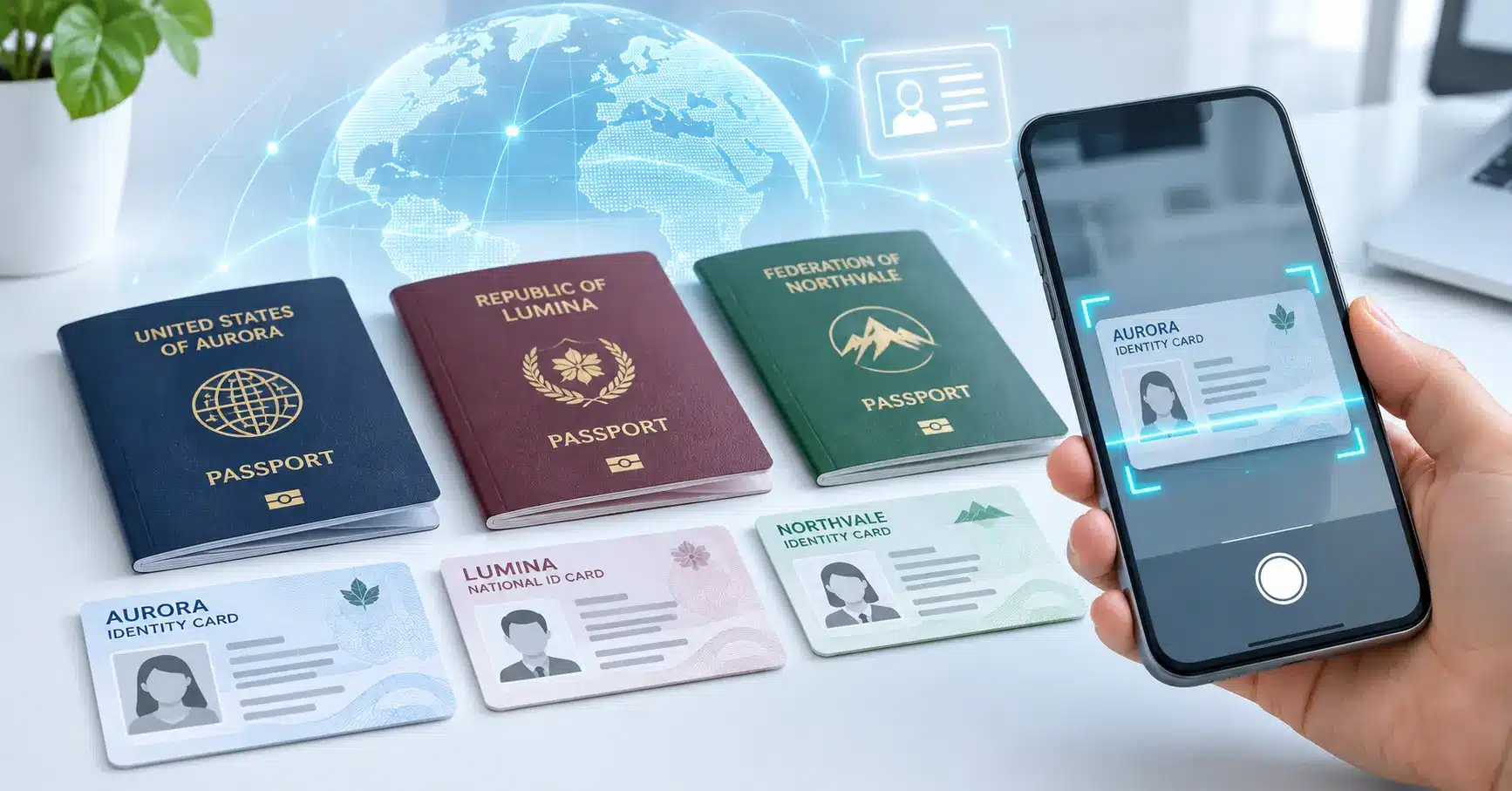
Multi-country ID recognition is an AI-powered technology that helps businesses automatically recognize and extract information from identity documents issued by different countries.
As businesses expand internationally, they must process passports, national identity cards, driver’s licenses, and residence permits with different languages, formats, and security features.
Traditional document verification methods often require manual data entry and extensive knowledge of international identity documents. These processes can increase operational costs and create unnecessary delays.
Artificial intelligence, computer vision, and optical character recognition (OCR) help address these challenges by automating document processing.
This guide explains how global ID recognition works, which technologies support it, its practical applications, and how developers can integrate document recognition into modern identity verification systems.
Table of Contents
-
What Is Multi-Country ID Recognition?
-
How AI Recognizes Identity Documents from Different Countries
-
Essential Technologies Behind Global ID Recognition
-
Benefits and Real-World Applications
-
Challenges and Security Considerations
-
How to Integrate Multi-Country ID Recognition
-
Frequently Asked Questions
1. What Is Multi-Country ID Recognition?
Multi-country ID recognition is the automated process of identifying, classifying, and extracting information from identity documents issued by different countries and territories.
Unlike traditional OCR systems that simply read visible text, specialized ID recognition solutions attempt to understand the structure and context of an identity document.
For example, a system may identify a French national identity card, a German passport, or a Canadian driver’s license before selecting an appropriate document-processing method.
What information can AI extract?
Depending on the document type and available features, AI-powered recognition systems can extract:
-
Full name
-
Date of birth
-
Document number
-
Nationality
-
Country of issuance
-
Expiration date
-
Residential address
-
Document holder’s portrait
-
Machine-readable information
Not every document contains the same information. A reliable recognition system must adapt its extraction process to the document being processed.
Supported identity document types
| Document Type | Common Information | Typical Application |
|---|---|---|
| Passport | Name, nationality, passport number | International travel and KYC |
| National ID card | Name, birth date, identity number | Customer identification |
| Driver’s license | Name, license number, expiration date | Vehicle rental and verification |
| Residence permit | Personal details and residency information | Residency verification |
| Visa | Travel authorization and validity dates | Immigration processing |
Businesses can explore MiniAiLive’s ID Document Verification solution to learn more about automated identity document processing.
ID Document Recognition+1
2. How AI Recognizes Identity Documents from Different Countries
Modern multi-country ID recognition systems combine several image-processing and data-extraction techniques.
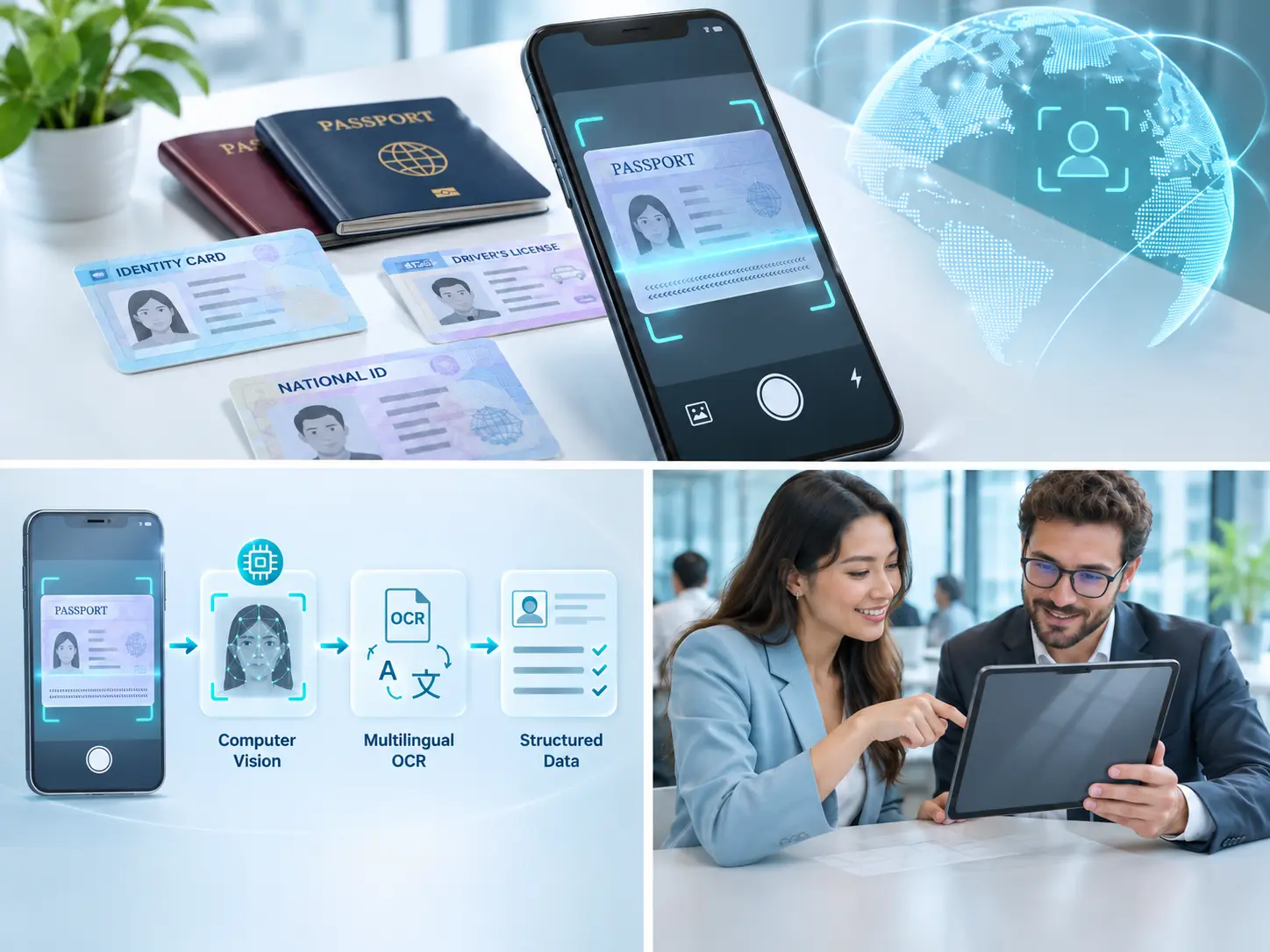
The recognition process typically involves six stages.
Step 1: Document capture
The user captures an identity document using a smartphone camera, webcam, scanner, or dedicated document reader.
The system evaluates image quality and identifies potential issues such as poor lighting, motion blur, reflections, and missing document edges.
A high-quality image provides a stronger foundation for accurate recognition.
Step 2: Document detection and preprocessing
Computer vision algorithms locate the identity document within the captured image.
The software may crop unnecessary background areas, correct perspective distortion, adjust brightness, and improve image clarity.
These operations help prepare the document for further analysis.
Step 3: Country and document classification
The recognition engine analyzes the document’s visual structure to determine its likely country of issuance, document type, and edition.
This stage is particularly important because different countries use different identity document designs.
A country may also issue several generations of the same identity document.
Step 4: Multilingual OCR extraction
Optical character recognition converts printed text into machine-readable information.
Advanced OCR engines can process multiple writing systems, including Latin, Cyrillic, Arabic, and Chinese characters.
The extracted information is then associated with meaningful data fields, such as the document holder’s name or expiration date.
Step 5: Machine-readable data processing
Some identity documents contain additional structured information, such as machine-readable zones (MRZs), barcodes, or electronic chips.
When supported, the recognition system reads these data sources and compares them with visible document information.
Inconsistent results may indicate a recognition error or a document that requires further investigation.
Step 6: Structured output and verification
The system returns extracted information in a structured format that applications can process automatically.
Businesses can use this information to populate registration forms, support KYC workflows, or initiate additional identity verification checks.
However, successful data extraction alone does not establish that a document is genuine.

3. Essential Technologies Behind Global ID Recognition
Multi-country ID recognition depends on several complementary technologies. Each performs a different function within the document-processing workflow.
Artificial intelligence and computer vision
Computer vision helps software interpret visual information within an image.
Machine learning models can learn patterns associated with document layouts, text regions, photographs, and document categories.
These capabilities help recognition systems process documents with different designs and structures.
Multilingual optical character recognition
International identity documents may contain multiple languages and writing systems.
Multilingual OCR helps businesses extract information without requiring customers to manually translate or enter their personal details.
However, uncommon fonts, damaged text, and complex character combinations can affect recognition accuracy.
Machine-readable zone recognition
Many passports and international travel documents contain an MRZ.
The MRZ provides standardized information that compatible systems can read automatically.
The International Civil Aviation Organization publishes specifications for machine-readable travel documents through its ICAO Doc 9303 standards.
Barcode and NFC reading
Some identity documents include barcodes or electronic chips containing additional personal information.
Compatible readers can extract this information and use it to support consistency or authenticity checks. NFC chip processing requires suitable hardware and software.
| Technology | Main Function | Benefit |
|---|---|---|
| Computer vision | Detect document structure | Improved image processing |
| Machine learning | Classify document types | Automated recognition |
| Multilingual OCR | Extract printed text | Reduced manual data entry |
| MRZ recognition | Read standardized travel document data | Efficient passport processing |
| Barcode reading | Extract encoded information | Additional data comparison |
| NFC reading | Access supported electronic chips | Stronger verification opportunities |
Combining these technologies helps businesses build more flexible international identity verification workflows.
4. Benefits and Real-World Applications
Multi-country ID recognition can provide significant operational benefits for organizations that serve international customers.
Faster customer onboarding
Automated document recognition can reduce the amount of information customers need to enter manually.
For example, a fintech application can extract personal information from a passport and populate relevant registration fields automatically.
Customers can then review their information before continuing.
Reduced manual data entry
Manual document processing can introduce typing errors, inconsistent date formats, and incorrect document numbers.
AI-powered extraction helps reduce repetitive administrative work while allowing employees to focus on exceptions and complex cases.
Improved international accessibility
Businesses can support customers from different countries without designing an entirely separate onboarding application for every market.
A multilingual document recognition engine can help accommodate different languages and identity document formats.
Who is multi-country ID recognition for?
| Industry | Practical Application |
|---|---|
| Banking | International customer onboarding |
| Fintech | Digital KYC verification |
| Travel | Passport information processing |
| Hotels | International guest registration |
| Insurance | Customer identity verification |
| Telecommunications | Subscriber registration |
| Human resources | Employee document processing |
| Vehicle rental | International driver’s license recognition |
Practical example: Global fintech onboarding
Imagine a financial technology company that serves customers across Europe, North America, and Asia.
Instead of asking every customer to enter their passport information manually, the application captures the document, identifies its type, and extracts relevant personal details.
The application then performs additional document authentication and identity verification checks according to its compliance requirements.
This approach can simplify the registration experience while maintaining appropriate security controls.
5. Challenges and Security Considerations
Although multi-country ID recognition offers valuable automation capabilities, international document processing remains a complex technical challenge.
Businesses should understand its limitations before implementing a recognition system.
Different document formats
Countries frequently update their identity document designs.
Older and newer document editions may remain valid at the same time. Recognition systems therefore need updated document libraries and appropriate testing across supported editions.
Image quality limitations
Poor lighting, damaged documents, reflections, and low-resolution photographs can reduce recognition accuracy.
Applications should provide clear capture instructions and allow users to retake unsuitable images.
Language and character differences
Names may contain special characters, accents, or multiple writing systems.
Developers should preserve original characters where possible and carefully handle transliteration, name ordering, and local date formats.
Identity document fraud
A recognition engine may successfully extract information from a counterfeit or digitally manipulated document.
Businesses should distinguish between three separate processes:
| Process | Purpose |
|---|---|
| Document recognition | Identify the document and extract information |
| Document authentication | Evaluate whether the document appears genuine |
| Identity verification | Establish whether the person is associated with the claimed identity |
Additional technologies, such as document liveness detection, face matching, and facial liveness detection, can support a more comprehensive verification workflow.
Privacy and data protection
Identity documents contain sensitive personal information.
Businesses should implement appropriate security measures, including encryption, restricted access, secure storage, and defined data retention policies.
The NIST Identity Proofing Guidelines provide useful guidance on evaluating identity evidence and establishing reliable identity verification processes.
Organizations must also evaluate the privacy and regulatory requirements applicable to their specific markets.
6. How to Integrate Multi-Country ID Recognition
Developers can integrate an identity document recognition SDK into mobile applications, web services, or backend systems.
A successful implementation requires careful planning, testing, and ongoing maintenance.
Choose a suitable ID recognition SDK
Start by identifying the countries and identity document types your application needs to support.
Evaluate language coverage, document editions, deployment options, recognition accuracy, and available data-extraction features.
According to its official documentation, the MiniAiLive ID Document Recognition SDK supports more than 14,000 document templates across over 250 countries and territories, with support for over 140 languages. These are vendor-reported coverage figures, and specific document support should be confirmed before deployment.
Create a document capture interface
Design a simple interface that helps users position their identity documents correctly.
Provide useful feedback when images are blurry, incomplete, or affected by excessive glare.
Connect the recognition engine
Integrate the SDK into your application and configure the required document-processing functions.
Depending on the implementation, recognition may take place on a mobile device or within a server environment.
Validate extracted information
Check that required fields are present and correctly formatted.
Allow customers to review extracted information when appropriate. Route uncertain recognition results to additional checks or manual review.
Add complementary verification methods
Combine document recognition with suitable document authentication and biometric verification technologies when stronger identity assurance is required.
Avoid treating a successful OCR result as proof of a genuine identity.
Test before production deployment
Developers should evaluate their implementation using authorized test documents representing relevant countries, languages, document editions, and capture conditions.
Important performance measurements include field extraction accuracy, document classification accuracy, processing time, failure rates, and manual review rates.
MiniAiLive provides additional information about server-based document processing in its guide to the ID Document Recognition Server SDK.
Developers can also explore the official ID Document Recognition SDK documentation and supported OCR languages.
7. Frequently Asked Questions
What is multi-country ID recognition?
Multi-country ID recognition is a technology that automatically identifies and extracts information from identity documents issued by different countries using AI, computer vision, and OCR.
Can AI recognize identity documents in different languages?
Yes. Multilingual OCR engines can recognize text from multiple languages and writing systems. Actual language coverage depends on the recognition software.
Can AI detect fake international identity documents?
AI can help identify suspicious document characteristics. However, document recognition alone cannot guarantee authenticity. Additional authentication methods and appropriate review procedures are necessary.
Can developers integrate ID recognition into mobile applications?
Yes. Compatible mobile SDKs allow developers to integrate document capture, classification, and data extraction into Android and iOS applications.
Is multi-country ID recognition suitable for KYC?
Yes. It can support international KYC workflows by automating identity document processing. However, businesses must implement additional checks to meet applicable identity verification and compliance requirements.
Key Takeaways
-
AI helps automate the recognition of international identity documents.
-
Multilingual OCR supports different languages and writing systems.
-
MRZ, barcode, and chip reading can provide additional information.
-
Document recognition and document authentication are different processes.
-
Reliable implementation requires testing, privacy protection, and exception handling.
Conclusion
Multi-country ID recognition is an important technology for businesses operating across international markets.
By combining artificial intelligence, computer vision, multilingual OCR, and document classification, organizations can simplify identity document processing and reduce repetitive administrative work.
However, reliable identity verification requires more than extracting personal information. Businesses should also consider document authenticity, biometric verification, data protection, and recognition limitations.
Explore MiniAiLive’s ID Document Recognition solution to learn how AI-powered document processing can support your international customer onboarding and identity verification workflows.