

Document Replay Attack Detection: 7 Essential Ways to Prevent Screen-Based ID Fraud
Document replay attack detection is an important security technology that helps businesses identify fraudulent identity documents presented through digital screens. Instead of providing a physical passport, driver’s license, or national ID card, fraudsters may present a digital reproduction during identity verification.
Traditional document recognition systems can extract information from images. However, reading information correctly does not necessarily prove that a physical document is present.
Artificial intelligence and computer vision help address this security gap. By examining document presentation characteristics, modern verification systems can identify suspicious submissions and reduce the risk of identity fraud.
This guide explains how document replay attacks work, how AI-powered detection helps prevent them, and how businesses can strengthen their remote identity verification processes.
Table of Contents
-
What Is Document Replay Attack Detection?
-
How Does Document Replay Attack Detection Work?
-
Seven Essential Ways to Prevent Screen-Based ID Fraud
-
Real-World Business Applications
-
Integration Challenges and Best Practices
-
Frequently Asked Questions
-
Conclusion
1. What Is Document Replay Attack Detection?
Document replay attack detection is a security process that identifies digital reproductions of physical identity documents presented during a verification session.
Its primary purpose is to increase confidence that an applicant is presenting an actual physical identity document rather than an image or recording displayed on another device.
Understanding screen-based ID fraud
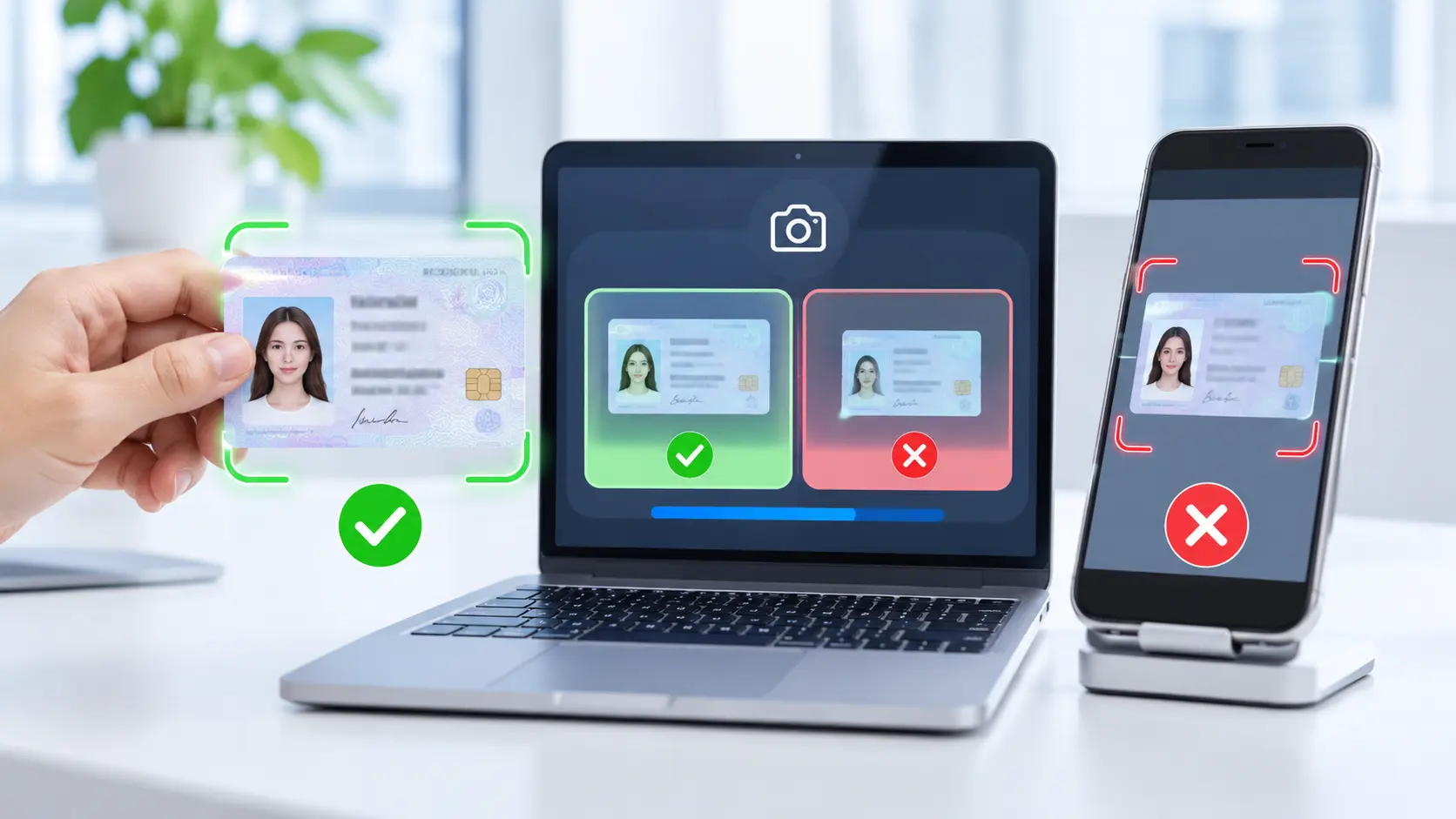
A screen replay attack occurs when a verification camera captures an identity document displayed on a digital screen instead of the physical document itself.
These attacks can affect remote customer onboarding, account verification, financial services, and other digital identity processes.
A document replay attack is a type of presentation attack because the fraudulent material is presented to the capture device.
Why traditional document recognition is insufficient
Optical character recognition (OCR) extracts information such as names, document numbers, expiration dates, and dates of birth.
However, accurate text extraction does not establish document authenticity or physical presence.
Document liveness detection adds another security layer by assessing how the document is presented.
| Verification technology | Main purpose |
|---|---|
| ID document OCR | Extracts document information |
| Document liveness detection | Evaluates physical document presence |
| Replay attack detection | Identifies suspicious digital reproductions |
| Document authentication | Evaluates document authenticity |
| Face matching | Compares the applicant’s face with the ID portrait |
| Face liveness detection | Evaluates whether a live person is present |
Combining these technologies can provide stronger identity assurance than relying on any individual method.
2. How Does Document Replay Attack Detection Work?
Modern document replay attack detection uses computer vision, artificial intelligence, and image analysis to evaluate captured identity documents.
The verification process generally involves several stages.
Document capture and quality assessment
The system captures the identity document using a smartphone camera, webcam, or compatible document scanner.
Before further analysis, it evaluates whether the captured content is suitable for verification. Poor lighting, excessive blur, and incomplete document visibility may require another capture.
AI-powered presentation analysis
Machine learning models evaluate visual and presentation characteristics to identify potentially reproduced documents.
Depending on the technology, the system may analyze individual images, multiple frames, or a live capture session.
The objective is to distinguish legitimate physical document presentations from suspicious reproductions without relying exclusively on text recognition.
Risk assessment and verification results
The verification system evaluates available evidence and produces a result that the application can use in its decision-making process.
A suspicious result may trigger additional verification, another capture attempt, or manual review.
The NIST Digital Identity Guidelines for Identity Proofing and Enrollment describe the importance of evidence validation and physical document presence checks in relevant remote identity proofing workflows.
3. Seven Essential Ways to Prevent Screen-Based ID Fraud
Businesses can improve document security by combining multiple fraud prevention technologies and operational controls.
1. Implement ID document liveness detection
Document liveness detection helps determine whether a physical document is present during identity verification.
The MiniAiLive ID Document Liveness Detection SDK is designed to identify several document presentation attack categories, including screen-based replay attacks.
Integrating document liveness checks can help businesses identify suspicious document presentations before completing customer onboarding.
2. Use secure document capture
A controlled capture process helps businesses maintain greater confidence in the origin of submitted images.
Applications should protect capture sessions, validate incoming data, and apply appropriate security controls throughout the verification workflow.
Uploaded images and live document captures may require different levels of identity assurance.
3. Combine document recognition and authentication
Document recognition and document authentication serve different purposes.
Recognition extracts information, while authentication evaluates whether the evidence is trustworthy.
Combining these capabilities with replay attack detection creates a more comprehensive identity verification process.
4. Apply document security feature verification
Some identity documents contain security features that specialized verification technologies can evaluate.
Depending on the document type and available hardware, these may include holograms, electronic chips, and other authenticity features.
Businesses should select verification methods appropriate to the documents they accept.
5. Combine face matching with face liveness detection
Document verification alone cannot establish that the applicant is the rightful document holder.
Face matching compares the applicant’s facial image with the portrait on the identity document. Face liveness detection provides additional evidence that a live person is participating.
These checks complement document replay attack detection rather than replace it.
6. Use risk-based verification decisions
Not every verification session requires the same level of investigation.
Businesses can combine document analysis results with other authorized security information to determine whether additional verification is necessary.
High-risk or inconclusive submissions may require further review by trained personnel.
7. Monitor and improve fraud prevention systems
Fraud prevention requires continuous evaluation.
Organizations should regularly assess verification performance, review suspicious cases, update security controls, and monitor the experience of legitimate customers.
The European Union Agency for Cybersecurity’s remote identity proofing good practices provide additional guidance for evaluating risks and improving remote identity verification.
4. Real-World Business Applications
Document replay attack detection is useful across industries that depend on reliable remote identity verification.
Banking and financial technology
Banks and fintech platforms use digital identity verification when customers create accounts or access regulated financial services.
Document liveness checks can help reduce the risk of accepting reproduced identity documents during KYC onboarding.
Cryptocurrency exchanges
Digital asset platforms may require identity verification before providing certain financial services.
Document presentation checks can support fraud prevention and identity assurance processes.
However, these checks do not replace other applicable compliance requirements.
Insurance services
Insurance companies can use document verification when processing applications, validating policyholders, or reviewing sensitive account changes.
Additional document security checks may help reduce identity-related fraud.
Government and digital identity services
Public institutions increasingly provide online services that require reliable identity verification.
Document authentication and physical presence checks can support secure access to these services.
Online marketplaces and rental platforms
Marketplaces, vehicle rental companies, and accommodation platforms may need to confirm customer identities remotely.
Document replay attack detection can provide additional protection when identity documents are required.

Who should use this technology?
| Target audience | Practical application |
|---|---|
| Fintech companies | Secure customer onboarding |
| Software developers | Integrate document anti-spoofing |
| Banks | Strengthen identity verification |
| Security professionals | Reduce document-related fraud risks |
| Government agencies | Protect digital identity services |
| Online service providers | Improve account verification |
5. Integration Challenges and Best Practices
Although document replay attack detection can improve security, no individual AI system can guarantee that every fraudulent submission will be identified.
Businesses should understand the limitations before deploying document verification technology.
Common implementation challenges
Verification performance may vary depending on document types, camera quality, supported devices, environmental conditions, and the characteristics of submitted content.
Organizations should evaluate their chosen technology using representative documents and realistic operating conditions.
False acceptance and false rejection
A false acceptance occurs when a fraudulent presentation is incorrectly accepted.
A false rejection occurs when a legitimate document presentation is incorrectly rejected.
Both outcomes can create problems for businesses. False acceptance increases security risks, while false rejection negatively affects customer experience.
Organizations should evaluate both outcomes when selecting and configuring verification solutions.
Privacy and personal data protection
Identity documents contain sensitive personal information.
Businesses should protect this information throughout the capture, transmission, processing, and storage stages.
Appropriate safeguards include encryption, restricted access, data minimization, secure deletion, and clearly defined retention policies.
Integrating the MiniAiLive SDK
Developers can explore the official MiniAiLive ID Document Liveness Detection SDK documentation to understand its document anti-spoofing capabilities and available integration information.
A general integration workflow includes:
-
Select an SDK appropriate for the application.
-
Configure a secure document capture process.
-
Process the captured document using liveness detection.
-
Combine the results with other identity verification checks.
-
Handle suspicious and inconclusive results appropriately.
-
Test the complete workflow before production deployment.
Developers should confirm platform compatibility, supported document types, available outputs, and processing requirements using the official documentation.
Key takeaways
Document replay attack detection is most effective as part of a layered identity security strategy.
Businesses should combine physical document presence checks with document authentication, secure capture, biometric verification where appropriate, and responsible data protection practices.
6. Frequently Asked Questions
What is a document replay attack?
A document replay attack involves presenting a digital reproduction of an identity document during verification instead of the physical document.
Can AI detect identity documents displayed on screens?
Yes. Specialized AI-powered document liveness detection technologies can help identify screen-based document presentation attacks. However, detection performance varies, and no system guarantees perfect accuracy.
Is document replay attack detection the same as OCR?
No. OCR extracts text from documents. Replay attack detection evaluates whether the document presentation may involve a digital reproduction.
Both technologies can work together within an identity verification system.
Can document liveness detection prevent all identity fraud?
No. Document liveness detection addresses particular presentation-related risks. Businesses also need appropriate document authentication, identity matching, application security, and fraud monitoring controls.
Can developers integrate replay attack detection into mobile applications?
Yes. Compatible document liveness detection SDKs can support mobile identity verification workflows. Developers should review the SDK’s official documentation for supported platforms and integration requirements.
7. Conclusion
Document replay attack detection is an essential component of modern remote identity verification. It helps businesses identify suspicious document presentations, reduce screen-based ID fraud risks, and strengthen digital customer onboarding.
Combining artificial intelligence, document liveness detection, document authentication, and secure capture provides a more comprehensive approach to identity security.
Businesses should also consider detection limitations, customer experience, privacy requirements, and continuous performance evaluation.
Explore MiniAiLive and its AI-powered identity verification solutions to discover how document liveness technology can strengthen your application’s fraud prevention workflow.