
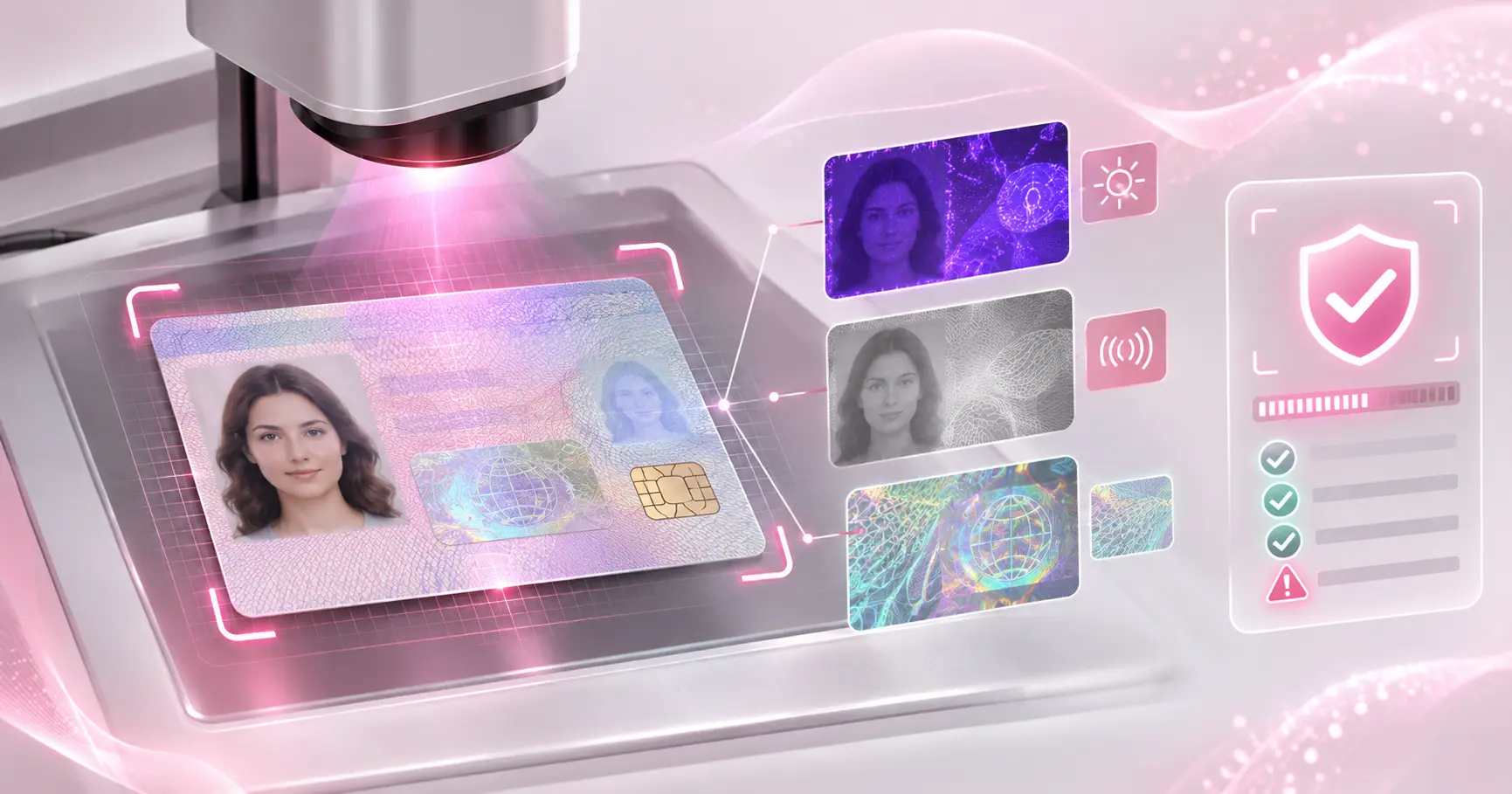
UV IR document verification is an advanced authentication technique that uses ultraviolet and infrared imaging to examine security features in identity documents that ordinary cameras may not reveal.
As digital identity verification becomes more common, businesses face increasingly sophisticated document fraud. Counterfeit passports, manipulated identity cards, and altered driver’s licenses can create significant security risks.
Traditional document scanning and optical character recognition are useful for extracting information. However, reading document data alone cannot establish whether a document is genuine.
Ultraviolet and infrared imaging provide additional security signals. When combined with artificial intelligence, computer vision, and document liveness detection, these technologies can support more reliable authentication decisions.
This guide explains how UV and IR verification works, its main benefits, practical applications, technical limitations, and integration considerations.
Table of Contents
-
What Is UV IR Document Verification?
-
How Ultraviolet and Infrared Verification Works
-
5 Powerful Security Checks for Detecting ID Forgery
-
Benefits and Real-World Applications
-
Technical Challenges and SDK Integration
-
Frequently Asked Questions
-
Conclusion
What Is UV IR Document Verification?
UV IR document verification is a multispectral document authentication method that examines identity documents under different lighting conditions.
Unlike conventional document scanning, it evaluates how document materials and security features respond to ultraviolet and infrared illumination.
Governments and document manufacturers incorporate various security features into official identity documents. Some are visible to the human eye, while others require specialized equipment.
What is ultraviolet document verification?
Ultraviolet (UV) document verification uses UV illumination to examine fluorescent security elements.
These elements may include:
-
Fluorescent security patterns
-
Embedded security fibers
-
Hidden document markings
-
Specialized security printing
-
Document material characteristics
The expected responses depend on the document type, issuing country, and document version.
What is infrared document verification?
Infrared (IR) document verification examines how document inks and materials interact with infrared light.
Specialized imaging equipment captures information that may not be apparent under ordinary visible light.
This provides additional evidence for detecting document inconsistencies and possible manipulation.
Who is this technology for?
UV and IR authentication is particularly relevant to financial institutions, government agencies, identity verification providers, security professionals, and developers building document authentication systems.
It is most useful in environments where stronger physical document authentication is required.
The UK government’s identity proofing and verification guidance recognizes UV and IR security-feature examination as part of document authentication.
How Ultraviolet and Infrared Verification Works
UV IR document verification combines specialized image capture, document recognition, computer vision, and authentication analysis.
A typical system examines the same identity document under multiple lighting conditions.
Step 1: Document image acquisition
The system captures images using compatible document scanning hardware.
Depending on the equipment, this may include visible-light, ultraviolet, and infrared images.
Image quality is important because poor positioning, reflections, and damaged documents can affect authentication results.
Step 2: Document recognition
AI-powered document recognition identifies the document category and, where supported, its issuing country and version.
This allows the verification system to select suitable authentication checks.
Step 3: Security feature analysis
Computer vision algorithms examine the captured images for expected security characteristics.
The system evaluates whether the available evidence is consistent with the recognized document type.
Step 4: Data extraction and consistency checks
Optical character recognition (OCR) extracts information such as names, document numbers, and expiration dates.
Additional checks can compare information from different document regions and machine-readable data sources when available.
Step 5: Authentication decision
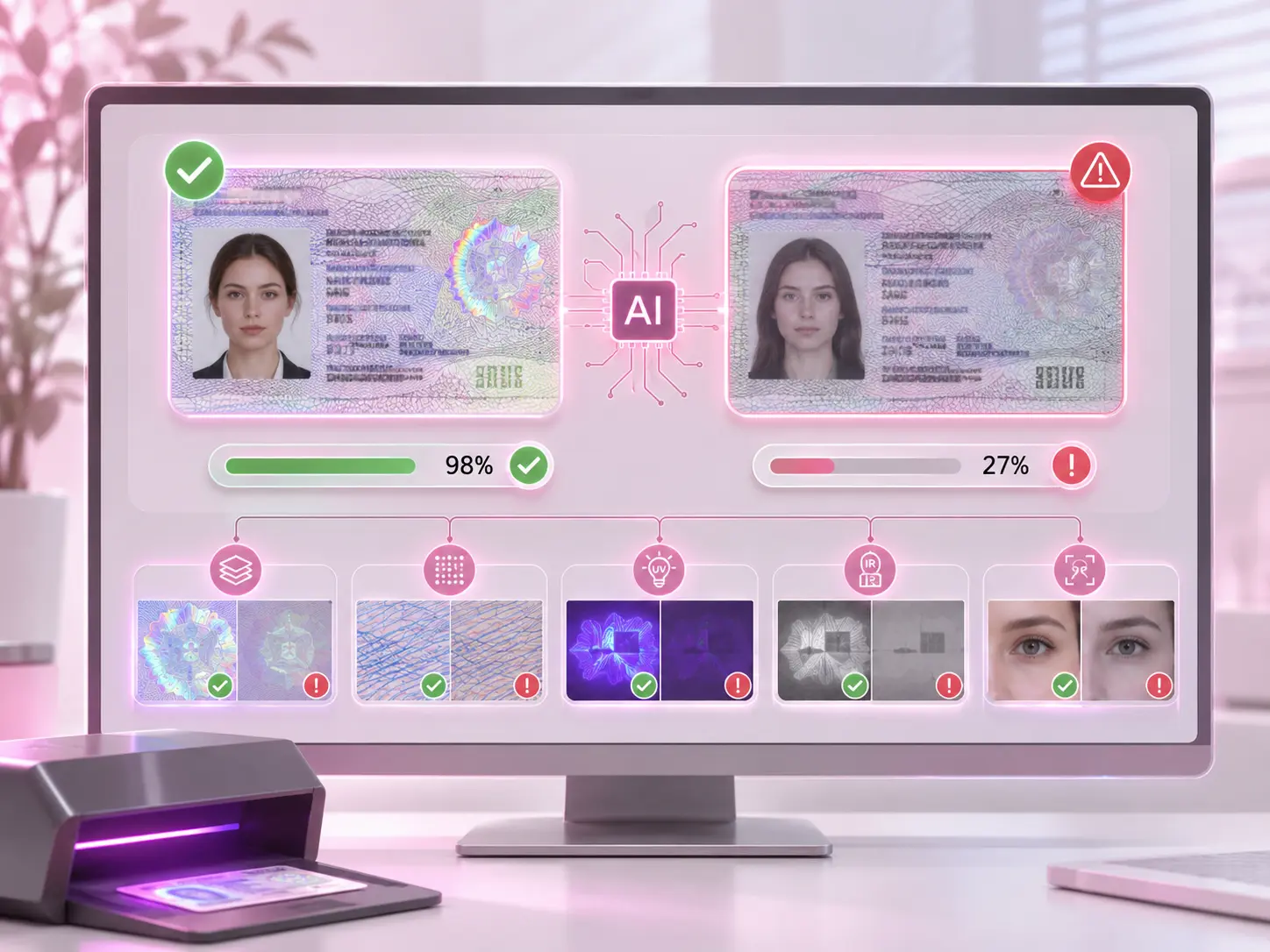
The system combines available verification signals to produce an authentication result.
Depending on the implementation, the document may be accepted, rejected, or referred for manual review.
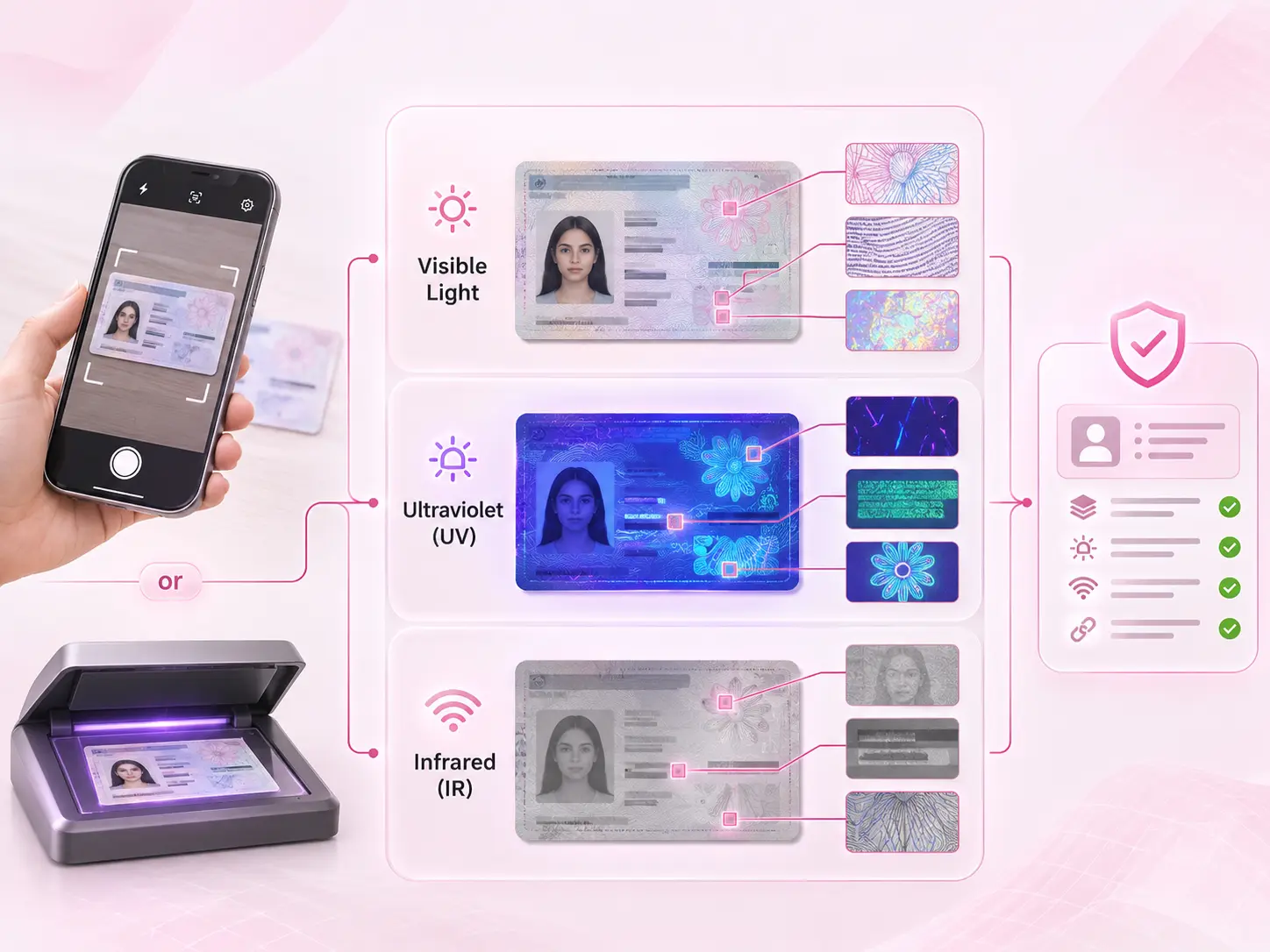
Visible light vs. ultraviolet vs. infrared
| Feature | Visible Light | Ultraviolet | Infrared |
|---|---|---|---|
| Primary purpose | Visual inspection | Fluorescence analysis | Material and ink analysis |
| Data extraction | Yes | Not primary purpose | Hardware dependent |
| Hidden feature examination | Limited | Supported | Supported |
| Specialized hardware | Not always | Required | Required |
| Authentication role | Basic inspection | Additional evidence | Additional evidence |
Combining these imaging methods provides a broader range of authentication evidence than visible-light inspection alone.
5 Powerful Security Checks for Detecting ID Forgery
Advanced document fraud requires more than basic visual inspection. UV IR document verification supports several complementary security checks.
1. Hidden security feature validation
Ultraviolet imaging helps verification systems examine fluorescent security elements that may not be visible under normal lighting.
Unexpected responses can indicate that a document requires further examination.
2. Document material authentication
Official identity documents may use specialized paper, plastic, or composite materials.
Multispectral imaging provides additional information about these materials. This helps authentication systems identify potentially suspicious documents.
3. Security ink analysis
Infrared imaging helps examine the optical behavior of document printing.
By comparing captured information with trusted document references, verification systems can identify inconsistencies that ordinary image recognition may overlook.
4. Document alteration detection
Fraudsters may manipulate identity documents to misrepresent personal information.
Multispectral examination can help identify suspicious areas that require additional authentication checks or professional review.
5. Multi-layer document authentication
UV and IR analysis becomes more valuable when combined with other security technologies.
These include:
-
Document liveness detection
-
Hologram detection
-
NFC chip verification
-
Face recognition
-
Face liveness detection
-
OCR and machine-readable zone (MRZ) validation
Businesses can explore the MiniAiLive ID Document Liveness Detection SDK to learn more about document presentation security.
Each technology addresses different risks. Combining them helps reduce dependence on a single authentication method.
Benefits and Real-World Applications
UV IR document verification can help organizations improve fraud prevention while supporting automated identity verification.
Stronger document authentication
Multispectral imaging provides additional information about physical security features.
This allows businesses to make authentication decisions using more than visible document appearance.
Improved fraud risk management
Suspicious documents can be identified and referred for further investigation before sensitive transactions or services are approved.
This is particularly useful for organizations handling high-risk customer onboarding.
Reduced manual workload
Automated document authentication can help security teams prioritize cases that require human review.
However, trained specialists remain important when verification results are uncertain.
Banking and financial services
Banks can incorporate multispectral document examination into branch-based customer onboarding and assisted identity verification.
For example, a bank may use a compatible document reader to authenticate an applicant’s passport before opening an account.
Airports and border control
Travel document authentication systems can use multiple imaging technologies to assist officers in evaluating passports and other travel documents.
Electronic chip authentication and database checks can provide additional evidence where available.
Hotels and hospitality
Hotels may use compatible document readers to examine guest identification during registration, subject to local privacy and identity collection requirements.
Government services
Government agencies can use document authentication systems when processing identity-related applications and other sensitive public services.
Enterprise security
Organizations can incorporate physical document examination into controlled employee onboarding, visitor registration, and secure facility access workflows.
Technical Challenges and SDK Integration
Although UV IR document verification provides valuable security information, successful implementation requires appropriate hardware, software, and operational procedures.
Hardware compatibility
Most conventional smartphone cameras cannot perform complete UV and IR document authentication without suitable additional equipment.
Businesses should evaluate hardware capabilities before selecting an SDK.
A compatible setup may require dedicated illumination, imaging sensors, and document scanning equipment.
International document variations
Identity document designs differ between countries and issuing authorities.
Documents may also change when governments introduce new security features.
Verification systems need maintained document reference information to support reliable authentication across different document versions.
Accuracy and environmental conditions
Document wear, reflections, poor positioning, and inconsistent illumination can affect image quality.
Businesses should evaluate authentication performance using representative documents and realistic operating conditions.
No document verification technology can guarantee perfect fraud detection.
Security and privacy
Identity documents contain sensitive personal information.
Organizations should protect captured images and extracted data throughout the verification process.
Important considerations include encryption, access controls, data minimization, retention policies, secure transmission, and appropriate audit logging.
The NIST Digital Identity Guidelines for Identity Proofing and Enrollment provide an authoritative resource for designing identity proofing systems and evaluating identity evidence.
Integrating MiniAiLive ID SDK
MiniAiLive introduced UV/IR-enabled document authentication capabilities with ID SDK 2.2.
Its subsequent ID SDK 2.3 release introduced additional NFC and hologram detection capabilities as part of a broader document verification approach.
Developers can learn more from the official UV/IR-enabled ID SDK 2.2 announcement and MiniAiLive ID SDK 2.3 release
Frequently Asked Questions
1. What is UV IR document verification?
It is a document authentication technique that uses ultraviolet and infrared imaging to examine security characteristics that may not be visible under normal lighting.
2. Can UV and IR verification detect every fake ID?
No. These technologies provide additional authentication evidence, but they cannot detect every form of document fraud. A layered verification approach is recommended.
3. What is the difference between UV and IR document scanning?
UV scanning primarily examines fluorescent responses, while IR scanning analyzes how document materials and printing interact with infrared light.
4. Can smartphones perform UV IR document verification?
Ordinary smartphones generally require compatible external hardware or specialized imaging capabilities to perform comprehensive multispectral document authentication.
5. Can UV and IR verification be integrated into KYC systems?
Yes. Compatible UV and IR authentication technologies can form part of a KYC workflow alongside document recognition, identity matching, liveness detection, and other risk controls.
Conclusion
UV IR document verification offers businesses an additional layer of protection against advanced identity document forgery.
By examining security characteristics beyond visible-light images, ultraviolet and infrared technologies can support more informed authentication decisions.
However, these technologies are most effective when combined with other identity verification methods and suitable security procedures.
Key Takeaways
-
UV and IR imaging provide complementary authentication signals.
-
OCR extracts information but does not independently establish authenticity.
-
Specialized imaging hardware is generally required.
-
Layered verification supports stronger fraud risk management.
-
SDK compatibility and document coverage should be evaluated before deployment.
Explore the MiniAiLive ID Document Recognition solution to learn how AI-powered document recognition and authentication technologies can support your identity verification applications.