

A license plate recognition API allows software applications to read vehicle license plates from images or video using artificial intelligence and computer vision. It helps organizations automate vehicle identification, parking operations, access control, and traffic management.
Traditionally, employees had to check vehicle registration numbers manually. Modern automatic license plate recognition (ALPR) systems can perform this task through cameras and specialized software.
However, successful implementation requires more than accurate character recognition. Developers must also consider camera quality, integration methods, data security, and privacy.
This guide explains how license plate recognition technology works, seven important features to evaluate, practical integration steps, and real-world applications. It also explores the limitations and best practices that businesses should understand before deployment.
Table of Contents
- What Is a License Plate Recognition API?
- How Does a License Plate Recognition API Work?
- 7 Essential Features to Look For
- How to Integrate License Plate Recognition
- Real-World Applications
- Accuracy, Privacy, and Security Considerations
- Frequently Asked Questions and Conclusion
What Is a License Plate Recognition API?
A license plate recognition API is an interface that allows an application to use software capable of detecting and reading vehicle registration plates.
This technology is also called Automatic License Plate Recognition (ALPR) or Automatic Number Plate Recognition (ANPR).
The recognition process commonly combines artificial intelligence, machine learning, image processing, and optical character recognition (OCR).
For example, a camera captures a vehicle entering a private parking facility. Recognition software finds the plate, reads its characters, and returns information that the parking system can compare with its authorized vehicle records.
Difference Between an API and an SDK
Although these terms are related, they do not mean exactly the same thing.
An API defines how one software component communicates with another. A remote recognition API might accept image uploads and return results through HTTP requests.
An SDK, or Software Development Kit, provides libraries and development tools that programmers can integrate into their applications. Some SDKs can perform recognition directly on a device.
Both approaches can support similar business workflows. However, their deployment requirements, network dependencies, and data-handling responsibilities may differ.
For example, MiniAiLive’s License Plate Recognition SDK describes photo and video recognition and support for Android and iOS platforms.
Developers should confirm which integration interfaces and deployment options are available before choosing an architecture.
How Does a License Plate Recognition API Work?
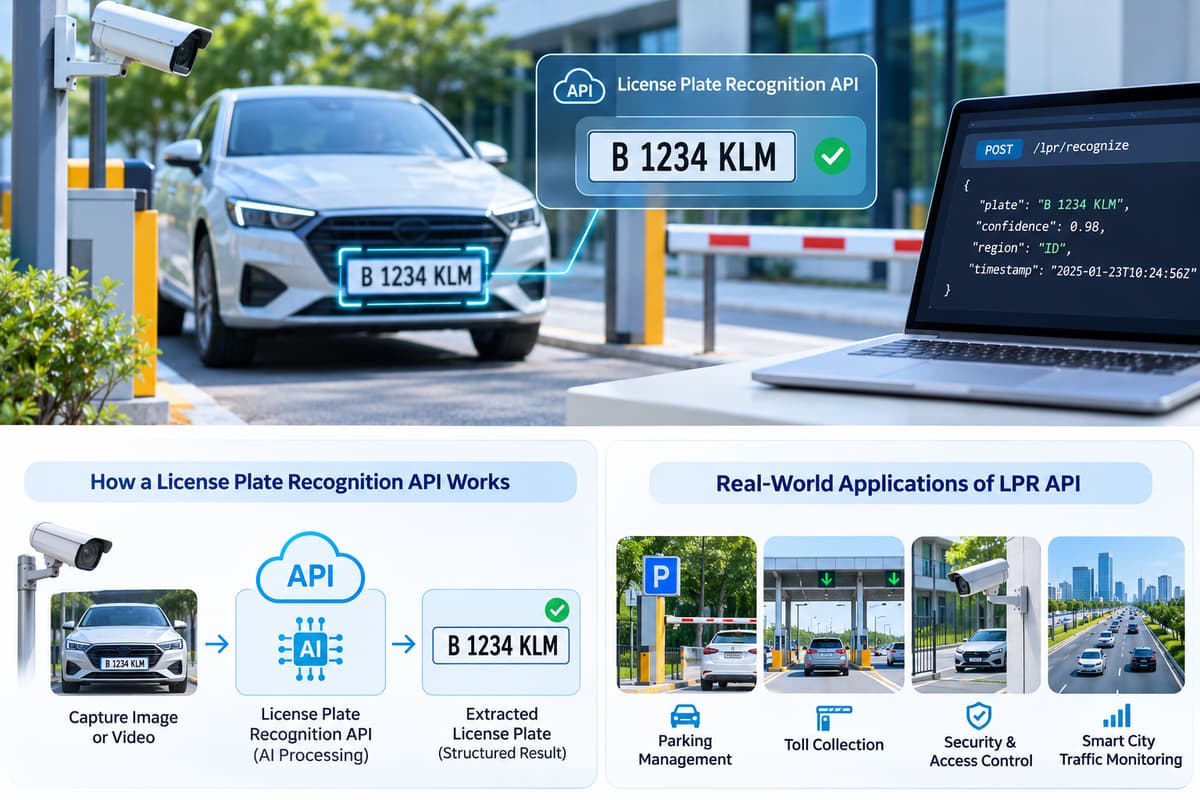
A license plate recognition system converts visual information into structured vehicle registration data.
The process usually includes several stages.
Step 1: Capture an Image or Video Frame
A camera records a vehicle entering its field of view.
The input may come from a security camera, parking entrance camera, mobile application, or another supported image source.
Camera positioning is important. The license plate should be sufficiently visible, correctly exposed, and large enough for recognition.
Step 2: Locate the License Plate
Computer vision software examines the image and identifies the area likely to contain the registration plate.
Modern AI-based systems may use object detection models to identify this region.
The detected plate can then be cropped for additional processing.
Step 3: Improve the Image
The software may adjust contrast, reduce noise, or correct perspective distortion.
These operations can improve readability when a plate appears at an angle or in challenging lighting.
However, image enhancement cannot reliably recover characters that were never captured clearly.
Step 4: Recognize Characters Using OCR
Optical character recognition converts the characters on the plate into machine-readable text.
For example, a camera image showing ABC1234 may produce the same character sequence as a recognition result.
Some systems use contextual rules to help distinguish similar characters, such as the letter O and the number 0.
Step 5: Return Structured Results
A recognition service can provide the extracted plate number to an application.
Depending on the implementation, additional information may include a confidence score, plate location, image reference, or recognition timestamp.
The application then decides what to do with the result.
For example, it may check an authorized vehicle list, create a parking record, or request manual verification.
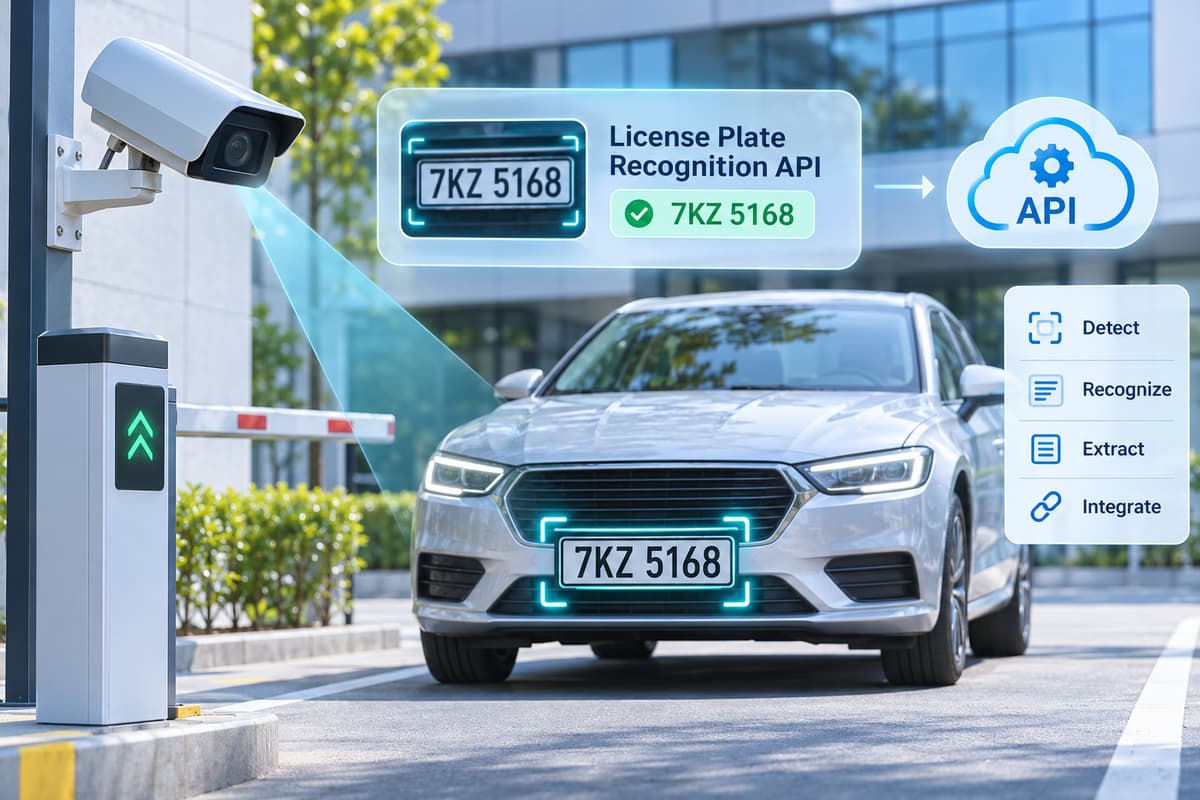
The U.S. Federal Highway Administration’s overview of automatic license plate readers explains how camera positioning, lighting, and visibility affect recognition performance.
7 Essential Features to Look For
Not every license plate recognition API provides the same capabilities.
Organizations should evaluate the following seven features before selecting a solution.
1. Reliable Plate Detection and OCR
The first requirement is accurate detection and character recognition.
A good system should distinguish license plates from other text appearing on vehicles, buildings, or signs.
Evaluate performance using real images from the intended environment rather than relying only on demonstration results.
2. Support for Different Plate Formats
Vehicle registration plate designs vary across countries and regions.
They can use different character arrangements, colors, fonts, and dimensions.
Organizations operating internationally should confirm which plate formats and jurisdictions are supported.
Support for a region should be verified with representative samples.
3. Image and Video Recognition
Some applications process individual photographs. Others need continuous video recognition.
Image processing is useful for mobile applications, manual checks, and uploaded photographs.
Video processing is useful for parking entrances, security checkpoints, and vehicle monitoring.
Choose the input method that matches the application.
4. Confidence Scores and Quality Feedback
Confidence information can help an application identify uncertain recognition results.
A low-confidence result may require another image, additional frames, or human review.
Confidence values should be evaluated and calibrated using deployment-specific data. They should not automatically be treated as guaranteed probabilities of correctness.
5. Structured Recognition Data
A useful integration should make recognition results easy to process.
Depending on the product, the output may contain the plate text, confidence information, bounding coordinates, and related metadata.
Developers should confirm the actual response format before implementation.
6. Integration and Deployment Flexibility
Consider whether a solution fits the existing application architecture.
Important questions include:
- Does it support the required operating system?
- Can it process the needed image or video inputs?
- Does it require network connectivity?
- What happens when processing fails?
- Can the deployment handle peak traffic?
API authentication, error handling, rate limits, SDK dependencies, and processing latency should also be assessed.
7. Security and Privacy Controls
A recognition system may process information that can be associated with an identifiable person.
Businesses should evaluate encryption, access controls, audit logs, data retention, and deletion capabilities.
The most appropriate solution is one that balances operational needs with lawful and responsible data handling.
How to Integrate License Plate Recognition
Integrating license plate recognition requires coordination between cameras, recognition software, application logic, and operational systems.
Step 1: Define the Business Workflow
Start by identifying the problem.
For example, a parking facility may need to recognize vehicles at entry and exit, calculate parking duration, and validate payment.
A corporate facility may need to check authorized vehicle registrations before opening a gate.
The workflow determines which information the application needs and when it must be available.
Step 2: Select the Integration Architecture
The main options include cloud-based API processing, local SDK processing, and edge-device processing.
| Integration Approach | Main Advantage | Main Consideration |
|---|---|---|
| Cloud API | Centralized service integration | Network connectivity and data transfer |
| Local SDK | Processing within an application or device | Device resources and platform compatibility |
| Edge processing | Recognition close to the camera | Hardware deployment and maintenance |
| Hybrid system | Flexible local and remote processing | Additional architecture complexity |
These are general architecture categories. The availability of each option depends on the selected vendor.
Step 3: Connect the Image Source
Configure a camera or application to capture suitable images.
Test different vehicle distances, viewing angles, lighting conditions, and plate sizes.
Avoid collecting unnecessary image data. Where practical, limit capture to the relevant area.
Step 4: Process the Recognition Result
Once the recognition component returns a result, the application can normalize the plate text and evaluate its quality.
It may also apply regional formatting rules and check the result against an authorized vehicle database.
Do not treat a single uncertain reading as proof of a particular vehicle’s presence.
Step 5: Connect Business Actions
The recognition result can support actions such as:
- Recording a parking entry or exit
- Checking a vehicle against an authorization list
- Sending a notification to an operator
- Creating a fleet arrival record
- Preparing a result for manual review
For high-impact decisions, include a suitable review or fallback process.
Step 6: Test, Monitor, and Maintain
Before production deployment, test the system with real operational conditions.
Measure plate detection rates, complete-string accuracy, false matches, and processing latency.
Also test error handling, network interruptions, duplicate detections, and incorrect plate readings.
Developers evaluating MiniAiLive can start with its official SDK documentation portal and confirm the specific LPR integration documentation and interfaces with the provider.
Real-World Applications
License plate recognition technology supports several practical business applications.
Smart Parking Management
Parking operators can automate vehicle entry and exit records.
A parking management application may use recognized plates to connect arrival and departure events, calculate parking duration, and support payment processing.
For example, a shopping center could use registration numbers to identify vehicles registered for its parking service.
A fallback process is still important when a plate cannot be read.
Vehicle Access Control
Businesses can use plate recognition to support controlled vehicle access.
A warehouse, office campus, or residential facility may compare an incoming plate with an authorization list.
If the system returns a reliable match and other access rules are satisfied, an access controller may allow entry.
The Axis license plate verifier API documentation provides a practical example of how recognition events can support vehicle access decisions.
Plate recognition should not be treated as strong proof of driver identity. Additional authentication may be needed for sensitive locations.
Toll Collection and Traffic Operations
ALPR technology can support tolling systems and transport operations.
Cameras capture vehicle registration information, which authorized systems can use as part of a tolling or traffic-management workflow.
Some transport systems also use plate observations at different locations to estimate travel times.
These uses require appropriate accuracy testing and data governance.
Fleet and Logistics Management
Fleet operators may use plate recognition to record vehicle arrivals and departures.
For example, a distribution center can recognize a registered delivery vehicle and connect the event to a scheduled appointment.
This can reduce manual registration work and improve the consistency of operational records.
It does not, by itself, provide continuous vehicle tracking or establish the identity of the driver.
Security and Facility Monitoring
Authorized security teams may use plate recognition to identify vehicles entering monitored areas.
The technology can support alerts, access records, and incident review.
However, recognition results can be wrong. Security teams should validate relevant information before taking consequential action.
Accuracy, Privacy, and Security Considerations
Although a license plate recognition API can automate repetitive tasks, its results depend on the complete system.
Common Accuracy Challenges
Several conditions can reduce recognition quality:
- Poor lighting or strong reflections
- Dirty, damaged, or partially covered plates
- Motion blur from moving vehicles
- Extreme camera angles
- Low image resolution
- Unusual fonts or regional plate designs
- Similar-looking letters and numbers
For example, a camera installed too high or too far from a roadway may capture plates at an angle that makes OCR less reliable.
The solution may involve better camera positioning, improved illumination, or collecting multiple frames.
Evaluating Recognition Performance
Developers should measure more than general accuracy.
Useful evaluation metrics include:
- Plate detection rate: How often a visible plate is successfully located.
- Exact plate match rate: How often every character is recognized correctly.
- False match rate: How often a result is incorrectly matched to another record.
- Processing latency: How long recognition takes under realistic conditions.
- Failure rate: How often the system cannot produce a usable result.
Test on representative vehicles, plate formats, and lighting conditions.
Do not assume that performance measured on one dataset will transfer unchanged to another environment.
Privacy and Data Protection
License plate records can become sensitive when combined with timestamps, locations, and other information.
Organizations should determine the lawful purpose of collection and limit access to authorized users.
They should also establish retention periods, deletion procedures, and appropriate notices.
For UK deployments, the Information Commissioner’s Office guidance on Automatic Number Plate Recognition explains important considerations involving personal data, retention, and transparency.
Legal obligations vary across jurisdictions and applications.
Secure API Integration
Developers should protect recognition workflows using appropriate security practices.
This may include encrypted connections, securely stored API credentials, least-privilege permissions, access logs, and data minimization.
Applications should validate incoming data and protect the systems connected to recognition results.
For automated gate control, a plate match should not be the only safeguard when the risk level requires stronger security.
Frequently Asked Questions and Conclusion
What is a license plate recognition API?
A license plate recognition API is a software interface that enables applications to use automatic license plate reading technology.
It connects recognition results with workflows such as parking management, vehicle access control, and traffic operations.
Can license plate recognition work in real time?
Yes. Some systems support recognition from live video or repeated camera frames.
Actual processing speed depends on the model, hardware, image quality, network conditions, and deployment architecture.
Does license plate recognition require internet access?
Not always.
Cloud APIs usually require a network connection to reach the processing service.
A locally deployed SDK or edge-based solution may operate without continuous internet connectivity, depending on its design and licensing requirements.
Can a license plate recognition API identify a vehicle’s owner?
Not by itself.
The recognition process reads visible registration characters. Identifying a registered owner would require access to separate records and appropriate legal authorization.
The technology also does not establish who is driving the vehicle.
Is license plate recognition always accurate?
No. Recognition systems can make mistakes, especially when plates are poorly captured or difficult to read.
Businesses should test recognition performance, monitor errors, and provide manual review or alternative verification where necessary.
Conclusion
A license plate recognition API can help businesses transform camera images into useful vehicle registration information.
Its main value comes from connecting computer vision with practical workflows, including parking management, vehicle access, fleet operations, and traffic systems.
However, successful deployment depends on more than recognition capability. Camera installation, integration design, security controls, accuracy testing, and privacy requirements all play important roles.
Organizations should evaluate their operating conditions and select technology that matches their actual needs.
To explore implementation options, review MiniAiLive’s License Plate Recognition SDK and its supported recognition modes. You can then assess the documentation and request the integration details needed for your application.