

A face anti spoofing SDK helps an identity verification system check whether the person seen by a camera is physically present, rather than a printed photograph, a replayed video, or another imitation. This matters whenever someone signs up for a financial service, recovers an account, or unlocks sensitive information remotely.
Face recognition alone answers whether two faces appear to belong to the same person. It does not necessarily establish that a live person is in front of the camera. Anti-spoofing adds that separate security check. In this guide, you will learn how presentation attacks work, which signals an SDK may examine, where the technology is useful, and how to evaluate it without assuming any solution is perfect.
What Is a Face Anti Spoofing SDK?
An SDK, or software development kit, provides components that developers can integrate into an application. A face anti spoofing SDK adds presentation attack detection (PAD) to a camera-based identity workflow. Its purpose is to distinguish a genuine face presented to the camera from an attempt to trick the biometric system.
A typical identity check has two different questions: Is this a live presentation? and Does this face match the enrolled person or identity document? The first is a liveness or PAD assessment. The second is biometric face matching. Both matter, but one cannot replace the other.
The ISO/IEC 30107-1:2023 framework defines terminology for biometric presentation attacks. Importantly, its scope concerns attacks at the capture device. A video inserted directly into an application’s camera pipeline is a different threat that needs additional protections.
Photos, Replays, and Other Presentation Attacks
A presentation attack happens when someone puts an object or representation in front of a biometric camera to influence its decision. Not every attack looks the same, so developers should test more than one example.
Printed photos and screen replays
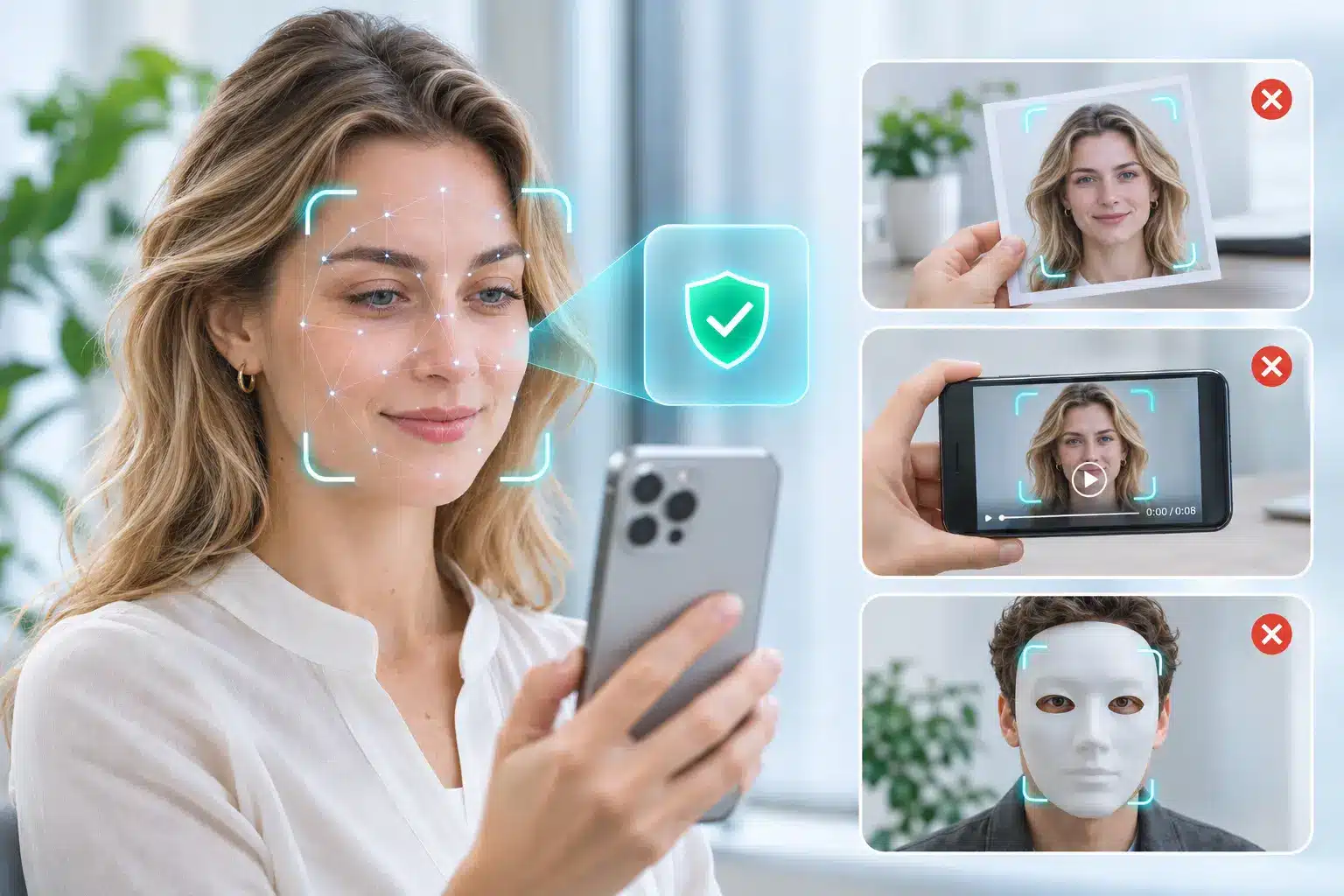
A printed face photograph may match an enrolled image, even though no person is present. An attacker might also hold a phone or tablet displaying a still portrait in front of the verification camera.
A replay attack uses previously recorded face footage on a screen. Unlike a still photo, it can include blinking, expression changes, and head movement. This makes simple rules such as “check whether the eyes blink” unreliable on their own. Anti-spoofing models may look for printing artifacts, display reflections, unusual texture, or inconsistent movement, but no single clue works in every situation.
Masks and synthetic faces
Three-dimensional masks can reproduce facial shape. Some attacks use realistic materials, while others rely on basic props. A deepfake played on a physical display can also be a presentation attack. However, a deepfake or prerecorded clip injected digitally into the capture stream bypasses the physical camera presentation stage. It requires separate capture-integrity or injection-detection controls.
| Attack type | What the camera receives | Potential detection signals | Important limitation |
|---|---|---|---|
| Printed photo | Flat paper portrait | Print texture, reflections, lack of natural depth | Good prints can hide obvious artifacts |
| Screen replay | Video shown on a device | Display patterns, glare, motion inconsistencies | Natural blinking may be present in the recording |
| 3D mask | Physical face-shaped object | Material texture, geometry, reflectance | High-quality masks can be difficult to classify |
| Digital video injection | Replaced camera data, not a physical presentation | Stream integrity, trusted capture path, injection checks | Camera-facing PAD alone may not detect it |
How Face Anti-Spoofing Works: 5 Defenses
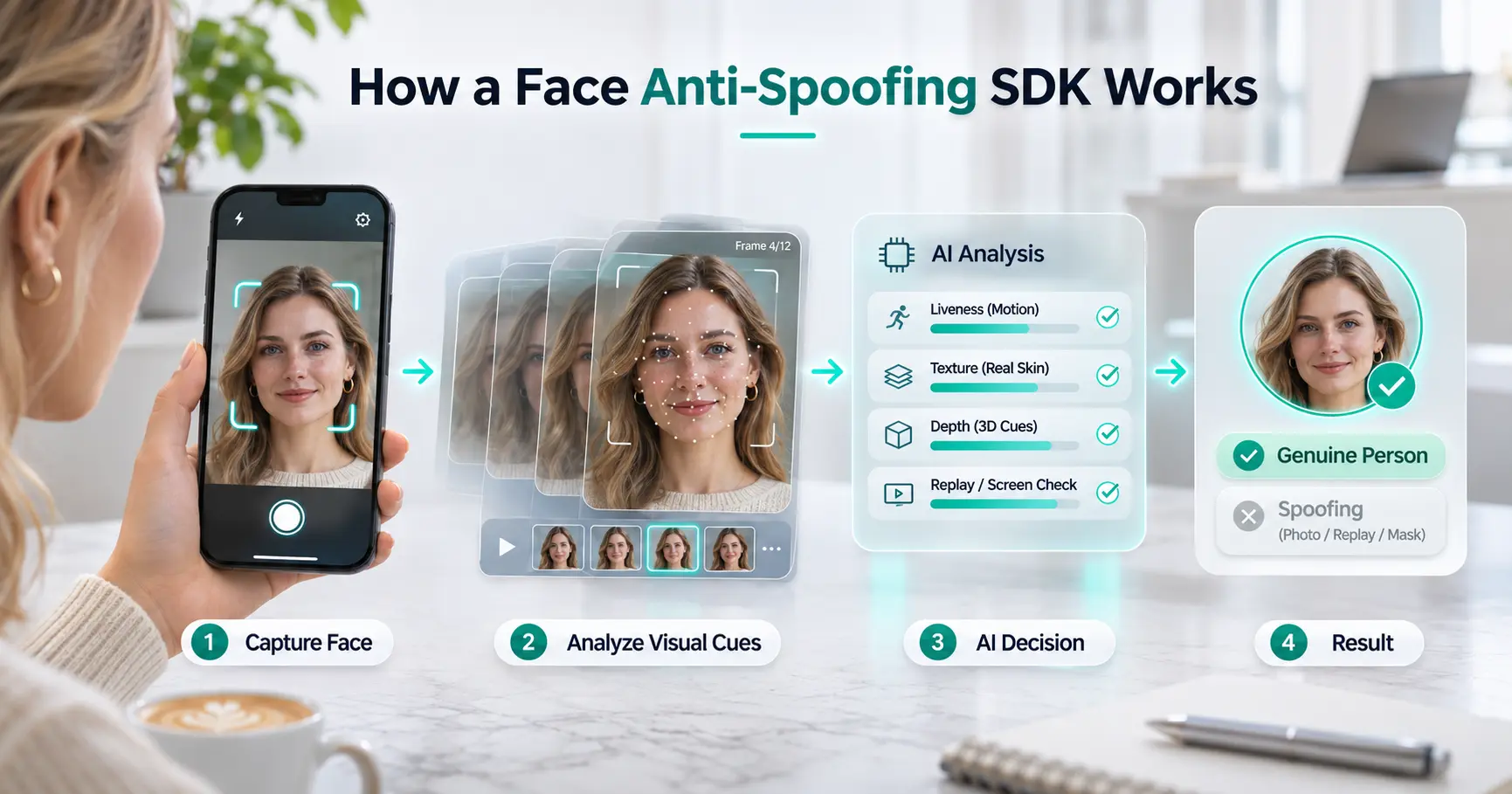
A face anti spoofing SDK can combine several checks instead of depending on one visual feature. The five defenses below describe common design approaches, not a claim that every SDK implements all five.
1. Check face capture quality
The application first detects a face and checks whether it is large enough, in focus, and adequately illuminated. A poor image may be impossible to classify reliably. Helpful prompts, such as moving closer to the camera or avoiding strong backlight, can prevent unnecessary failed attempts.
2. Analyze texture and display artifacts
Passive liveness detection can examine facial imagery without requiring a user to perform a special action. Machine-learning models may learn differences between natural skin and recaptured images, including print patterns, screen artifacts, and unusual light reflections. These are statistical clues, not proof by themselves.
3. Examine motion and depth cues
Across video frames, a system can inspect whether facial motion and perspective are consistent with a real three-dimensional face. Certain implementations may use optical flow, multiple frames, or dedicated depth sensors. Ordinary RGB cameras do not automatically provide reliable measured 3D depth, so capabilities depend on the device and model.
4. Add active challenges when appropriate
An active check asks the user to perform an action, such as turning their head. A randomized challenge can help test whether the observed response happened during the current session. However, active checks add friction, may create accessibility barriers, and do not guarantee protection against sophisticated attacks.
5. Make a risk-aware decision
The final result may combine liveness signals, image quality, face matching, and transaction risk. Depending on policy, the application can accept, reject, ask for a retry, or request human review. High-risk actions may need additional authentication. Protecting the camera input and transmission path matters just as much as choosing a classification threshold.
Where Face Anti-Spoofing Is Used
Digital onboarding and KYC. A face anti spoofing SDK can add an important safeguard when a fintech application asks for an identity document and a selfie. Liveness detection helps assess whether the selfie came from a present person; face matching then compares the selfie with the document portrait. Document authenticity requires its own checks.
Account recovery. When someone loses access to an account, a live-face check can be part of a step-up verification process. It should sit alongside recovery safeguards, rather than becoming the only way to regain access.
Workplace and service access. Face-based access control can benefit from presentation attack detection, especially where a photograph could otherwise be presented to a camera. Teams must also consider lighting, user consent, accessibility, and an alternative method for people who cannot complete a face check.
How to Integrate and Evaluate an SDK
MiniAiLive’s Face Liveness Detection solution describes passive anti-spoofing and mobile and server deployment options. Its Face Liveness Detection SDK documentation also discusses active and passive modes and client-side face capture. These are documented product descriptions, not an independent performance guarantee. For identity matching, explore MiniAiLive’s separate Face Recognition solution.
Build a secure capture-to-decision workflow
A practical integration should identify the camera source, capture suitable frames, perform the liveness assessment, and transmit only the information needed by the verification service. The backend should associate a result with a specific session and enforce the final authorization decision. Never trust a client-supplied “passed” flag without verifying its authenticity.
Before selecting an SDK, confirm its supported operating systems, camera requirements, offline or server processing options, result format, licensing, and data handling. Ask for implementation instructions specific to the SDK version you will deploy. Do not assume the same API, sensors, or features exist on every platform.
Test accuracy, security, and usability
A face anti spoofing SDK should be evaluated against realistic attacks, not just an ideal selfie captured under studio lighting. Build test cases covering printed portraits, phones showing recorded videos, varied screen brightness, and relevant mask materials. Include everyday conditions such as low light, glasses, different camera models, and varied skin tones.
Two useful PAD error measures are APCER, the rate at which tested attacks are incorrectly treated as genuine, and BPCER, the rate at which genuine presentations are incorrectly treated as attacks. The balance changes with the decision threshold and test conditions. The ISO/IEC 30107-3:2023 standard provides principles for PAD testing and reporting. NIST’s Face Analysis Technology Evaluation for PAD shows why results differ across attack types and algorithms. Neither source, by itself, verifies a particular vendor’s performance.
Protect biometric data through encryption, limited access, clear retention rules, and deletion procedures. Review applicable privacy requirements and provide an accessible alternative when liveness capture fails. Finally, assess digital injection threats separately: passing a presentation-attack test does not prove the camera stream cannot be replaced.
Frequently Asked Questions
Can a face anti spoofing SDK detect a replayed video?
It can help identify videos shown to a physical camera by analyzing visual and temporal clues. Detection depends on the model, recording quality, device, and test conditions. It is not a guarantee against every replay.
Is passive liveness better than active liveness?
Neither is always better. Passive checks can be more convenient because they require little interaction. Active checks add a challenge but may increase drop-off or create accessibility difficulties. Select a method based on the threat model and user experience.
Is anti-spoofing the same as face recognition?
No. Anti-spoofing checks the authenticity of the face presentation. Face recognition compares facial features to determine whether identities match. A secure onboarding workflow may use both technologies.
Does PAD stop deepfake and virtual-camera attacks?
A deepfake displayed on a screen may be evaluated as a presentation attack. A synthetic feed injected directly into camera data is a different attack route. Digital stream integrity and injection detection must be evaluated separately.
Conclusion
A face anti spoofing SDK can reduce the risk of fraudulent identity checks by looking for printed photos, display replays, masks, and other presentation attacks. Strong implementations combine appropriate detection signals, careful testing, secure capture, and sensible fallback decisions. No single liveness result proves an entire identity workflow is secure.
For a practical starting point, review MiniAiLive’s face liveness detection options and compare them with your platform requirements, attack scenarios, and privacy obligations before integrating a solution.